
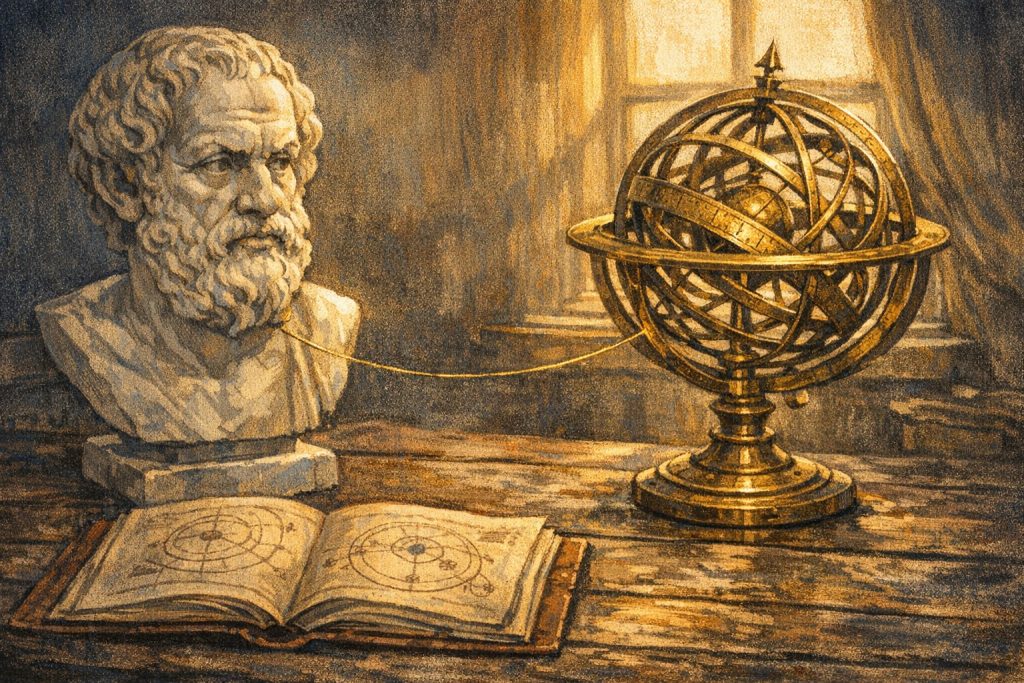
Lately, I have set the science books aside and turned back to philosophy, the field that has fascinated me for as long as I can remember. There is something genuinely admirable about philosophers: the depth of their thinking, the patience they have for questions most people would rather leave alone, and the precision with which they can expose a hidden assumption in someone’s argument. Watching a skilled philosopher gently dismantle a confident claim — not with data, but with a carefully drawn distinction — is one of the more beautiful intellectual performances I know of.
What fascinates me even more is the tradition, especially lively in debates around theism and atheism, of people who believe they can settle enormous questions without ever appealing to empirical evidence. They do it with reason alone: by probing definitions, exposing contradictions, and following the logic of a claim until it either stands or collapses. Whether or not this actually works is another question, but the ambition itself is remarkable.
The Charge That Philosophy Is Dead

And yet, if you listen to some prominent scientists, like Krauss and the late Stephen Hawking, you will hear a very different story. Philosophy, they say, is dead. It cannot teach us anything about the actual world. The scientific method has earned this dismissal, so the argument goes, by the sheer scale of what it has delivered over the last few centuries — from the structure of DNA to the age of the universe. The worry behind the rhetoric seems partly pedagogical: if people are told that philosophy provides genuine answers, they may stop looking to Science for them and settle for something that feels deep but is not actually tethered to reality.
The worry is not entirely baseless. Take Anselm’s Ontological Argument for God, which I touched on in my last post. Whether it would actually convince anyone who did not already want to be convinced is debatable, but some people do accept arguments like it — and, having accepted them, feel no particular need to consult what modern cosmology has to say about the origin of the universe. The argument, they feel, has already done the work. In cases like this, philosophy seems to function as a shortcut that bypasses the world rather than as a tool for understanding it.
Descartes provides another example. He famously argued that animals are essentially machines, lacking consciousness or inner experience. This is precisely the kind of claim that cannot be settled from an armchair. Whether a dog feels pain, whether an octopus has something like an inner life — these are questions that require us to get up, walk outside, and look. You can reason about consciousness all you want, but at some point you have to examine nervous systems, run experiments, compare behaviours, and test predictions. Philosophy alone will not tell you whether Descartes was right about your cat.
This, I think, is the real grievance some scientists have. It is not that philosophy asks silly questions; it is that philosophy too often starts from a conclusion it wants to reach and then constructs a path back to it. Done badly, it is motivated reasoning dressed up in formal clothing. Scientists, whose entire discipline is built on being wrong in public, can be forgiven for finding this frustrating.
But are they right to dismiss philosophy wholesale? I do not think so.
What Philosophy Actually Is

It is worth pausing over what philosophy actually claims to be.
“The study of the fundamental nature of knowledge, reality, and existence.” — Oxford Dictionary
“Philosophy (from Greek φιλοσοφία, philosophia, literally ‘love of wisdom’) is the study of general and fundamental problems concerning matters such as existence, knowledge, values, reason, mind, and language.” — Wikipedia
Notice what is happening in these definitions. Philosophy concerns itself with the nature of knowledge itself — with what it means to know something, what it means for a claim to be true, and what kind of thing reality fundamentally is. Science, by contrast, comes from the Latin scientia, meaning knowledge, and is the enterprise of building knowledge in the form of testable explanations and predictions about the universe.
Put bluntly, philosophy studies the nature of the very thing science tries to accumulate.
This is not a small or decorative role. It means philosophy can ask whether a given question even belongs to Science in the first place, and if so, how Science should go about answering it. Philosophy can ask what it would mean for a claim to be objectively true. It can ask whether a hypothesis is coherent before anyone wastes time and money testing it. If you want to know whether we are living in a computer simulation, for example, you first need a philosopher to tell you what that claim actually means and whether any conceivable experiment could, in principle, detect it. Only then does the scientist have something well-defined to work with.
Consciousness is perhaps the clearest example. Philosophy has been wrestling with it for millennia, and neuroscience will likely eventually make enormous progress here — possibly even solve it in some form. But Science cannot begin by asking “what is consciousness?” without first doing some philosophy. The question itself has to be sharpened. What are we pointing at? Subjective experience? Self-awareness? The capacity to report on one’s own states? Each of these is a different target, and confusing them has led to endless wasted effort. The moment a scientist asks, “What exactly do I mean by consciousness?” they have stopped being a pure empiricist and started doing philosophy, whether they call it that or not.
Where Science Cannot Go Alone

It is tempting to think philosophy only shows up at the beginning, posing the questions, and then hands the microphone to Science for the answers. But this is not quite right either. There are questions that Science, by its very nature, cannot answer on its own.
Ethics is the obvious case. Science can tell us an enormous amount about animal cognition — that many mammals have a developed prefrontal cortex, that fish show behaviours consistent with something like pain, and that octopuses exhibit problem-solving abilities that shocked researchers who encountered them. These are empirical facts. But the facts alone do not tell us what we ought to do about factory farming. To get from “animals probably suffer” to “we should not make them suffer gratuitously” requires moral reasoning — philosophy — built on top of the scientific findings. The flow here runs in both directions: Science informs philosophy, and philosophy, armed with that information, tries to say something about how we should live.
One might object here that free will is itself an illusion, that ethics therefore reduces to neuroscience, and that everything will one day be explained at the level of neurons, molecules, and ultimately subatomic particles. It is a popular move. But notice that even if neuroscience completely described why a particular person committed a particular act of violence, it would not thereby tell us whether that act was wrong. It would explain the mechanism, not evaluate the action. The descriptive and the normative are different registers, and no amount of detail in the first automatically resolves the second.
I will not get further into free will here because the debate is deep enough to swallow any essay that wanders into it. For now, it is enough to note that Science has not disproved free will, and that we all continue to live our lives as if we have it. Whether we actually do is, for the moment, still largely a philosophical question.
Philosophy as a Discipline of Thinking
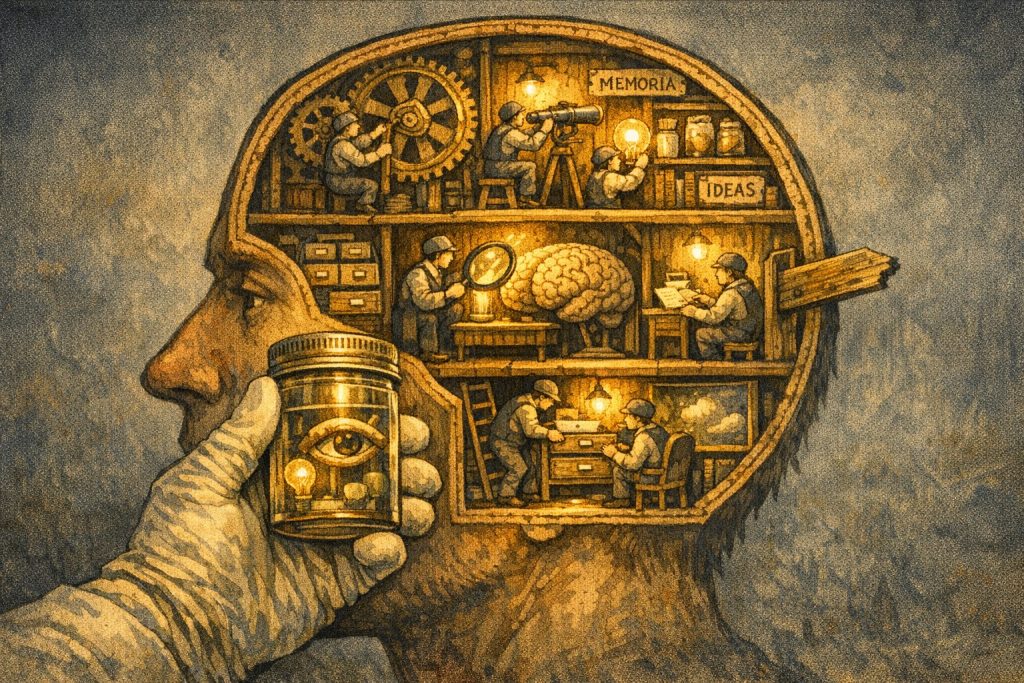
There is another, quieter benefit to philosophy that often gets overlooked in these grand debates: it teaches you how to think.
I do not mean this as a platitude. I mean that doing philosophy seriously — reading it, wrestling with it, trying to articulate your own positions — trains a specific set of skills. You learn to identify hidden assumptions in an argument. You learn to construct alternative explanations for the same phenomenon, and then to ask whether those alternatives could in principle be distinguished. You learn to notice when you are reasoning toward a conclusion you want to be true, rather than toward the conclusion the evidence actually supports. That last one, in particular, is a skill most people never develop, and it is arguably more valuable in daily life than any specific philosophical doctrine.
Good philosophy is introspective in this sense. It forces you to check your own motives, to distinguish between what you wish were true and what you have reason to believe is true. Scientists are not exempt from this kind of self-deception; nobody is. A philosophical habit of mind is one of the better defences against it.
A Plea for Peace

My tentative conclusion, then, is this. Rationalising carefully is not a waste of time. In many cases, scientists could save themselves enormous effort by doing good philosophy first — by thinking clearly, avoiding common fallacies, checking whether a hypothesis even makes logical sense before designing an experiment around it, and asking sharper questions from the start. Philosophers, in turn, cannot afford to ignore Science, because Science is what actually tells us how the world is, and any philosophical argument whose premises contradict well-established scientific findings is built on sand.
What I would like to see — and what I rarely do see, in the popular debates at least — is the two disciplines treating each other as collaborators rather than rivals. Philosophy sharpens the questions; Science tests them against reality; and the answers, once in, feed back into new philosophical work. That is how it is supposed to go.
My wish is simply that Science and philosophy make peace. Too often, I see them opposed to each other, each defending its territory against the other, when in truth they have always needed each other to get anywhere worth going.
Footnotes:
- I say “argued” with some hesitation because Descartes’s actual position is more subtle than the caricature suggests, and scholars continue to debate what he really meant.
- Adapted from the standard definitions in philosophy of science textbooks.





Comments