



A confession
I’ll start with the evidence against me.
I journal on a reMarkable Paper Pro. Before buying it, I compared it with the Kindle Scribe and read up on how fast the pen nibs wear down. I looked into the keyboard folio and even considered pairing it with a smaller model for when I’m away from my desk.
I’ve also journaled on legal pads with a good rollerball. And I’ve spent more time on the paper-versus-screen question than I’d like to admit.
The reMarkable is close to a perfect specimen of what this post is about. It’s a new, shiny gadget whose whole pitch is that it feels like old paper—both temptations, one device.
So this isn’t written from above; it’s written from inside the problem. We get so busy choosing, setting up and showing off our tools that we do less with them. And most of the time, the tool isn’t what’s stopping us.
Every new medium talks about itself first
If you were on Twitter in its early years, you’ll remember how much of it was about Twitter. How to use it, what it was for, who had just joined, whether it would last. Early blogs were much the same, and plenty of them were blogs about blogging.
Some curiosity about a new tool is natural. The trouble is that it never really ends. It just moves on to the next tool, and many of us move with it.
Today, it’s AI. Much of the conversation is about the tools themselves: which model, which prompt, which workflow, which feature launched this week. Far less of it is about anything that got made.
(This post was written with AI assistance, too. It gets one line at the bottom, which feels like the right amount.)
New and shiny
A new tool always makes the same promise: this time you’ll finally be organised, focused, consistent. Switching feels like progress. You import your old notes, rebuild your folders, try three themes, watch a tutorial and adjust the settings.
It all feels productive. Very little of it is.
Then comes the setup tour: the video or post that walks through someone’s “second brain” in loving detail. It shows the system off. What it rarely shows is anything the system was used to make.
And when the new tool turns out to be just a tool after all, the search starts again. It’s the grass-is-greener loop I’ve written about before, only with a receipt.
Old things can be shiny too
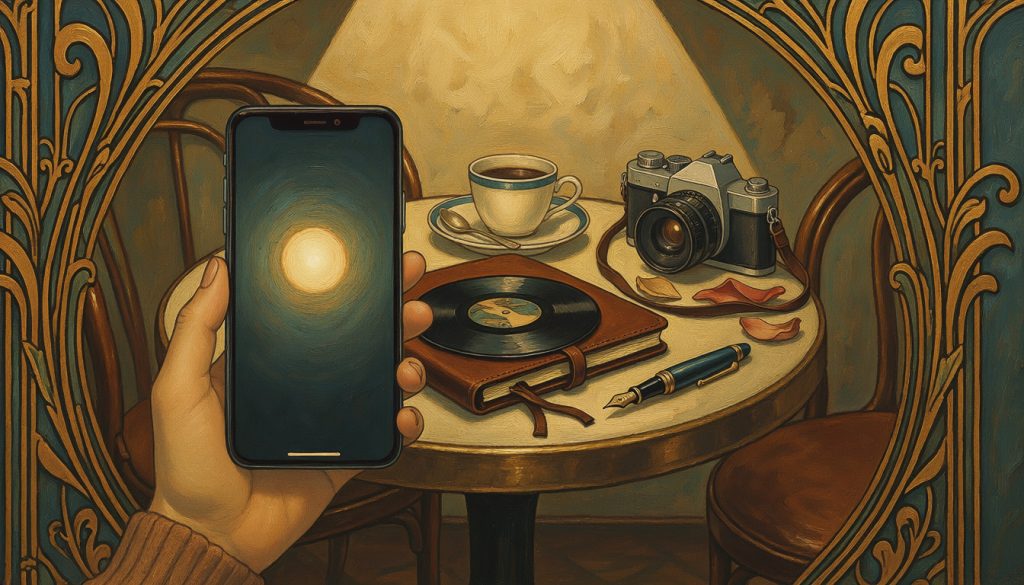
Going analogue presents itself as the cure. Put the apps away and pick up a fountain pen, a paper planner, a film camera, a record player, a dumbphone. Slow down. Be intentional.
But look at the move being made: choosing a tool for the story it tells about you. The shiny-new crowd buys “optimised”; the analogue crowd buys “intentional”. It’s the same purchase with a different label.
Going analogue also comes with an irony the shiny-new crowd is spared. It sells itself as the exit from the attention economy, then collects its reward inside it. The digital detox gets announced on the platform it’s a detox from.
The notebook is offline. The photo of the notebook isn’t.
The economist Thorstein Veblen described something similar over a century ago. In The Theory of the Leisure Class (1899), he called it conspicuous leisure: time spent visibly and unproductively, as proof that you can afford it. Slow tools on display do the same job: they signal that you can afford to be slow.
At work, someone else pays
At home, you at least pay for your own shiny object. At work, you share the bill.
A tool chosen by one person gets learned, maintained and worked around by everyone else, often for years. Whoever chose it may get the credit.
The most common justification is also the weakest: everyone does it. In software, that’s how small applications end up on infrastructure built for Google-sized problems (Kubernetes is the usual suspect). Nobody asked whether we actually have Google’s problems.
Even finding out whether a new tool is better costs someone’s time: the research, the trial run, the hours spent comparing. That’s why “we’ve always done it this way”, the phrase everyone loves to mock, is usually the smarter bet in an existing project. It isn’t laziness; it’s knowing that changing the tool is not the same as doing the work.
A good tool disappears
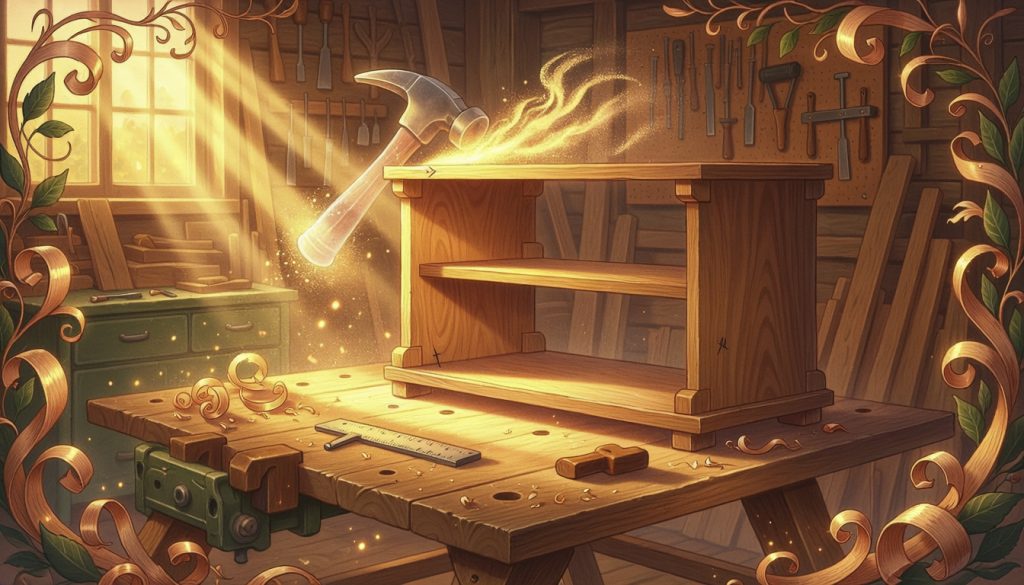
In Being and Time (1927), Martin Heidegger makes a famous observation about the hammer. While you’re hammering, you don’t think about the hammer; you think about the nail, the board, the thing you’re building. The hammer disappears into the work.
You only notice it when it breaks, or when you stop working and stare at it.
That’s the tell. If you’re thinking about the tool more than the work, the tool isn’t working, however good it is. A setup you keep tweaking, a notebook you keep photographing, a system you keep explaining: each one is a hammer you’re staring at.
Most tinkering is a hobby dressed up as productivity.
The test
Before changing tools, ask four questions:
- What would I accomplish with it that I can’t now?
- Is the tool really what’s stopping me?
- What won’t get done while I research and switch?
- Would I want it if nobody could see it?
Pass all four and switch. I’ve argued for one such switch myself, in my series Why You Should Go Digital. But most switches don’t pass, and they usually fail at the second question, because the honest answer is no.
Stop talking about it.
The surest sign a tool works is that you’ve stopped talking about it. Twitter only got interesting once people stopped tweeting about Twitter.
Which brings me back to the reMarkable. Honestly, it passes all four questions, but only in hindsight, because I never asked them.
I wanted fewer notebooks lying around, no more switching between them, and something easier to carry. Those are practical reasons, but I never checked them against anything. I got lucky that it passed.
A good outcome isn’t the same as a good decision.
Next time, I’ll ask the four questions before the research, not after. The principle stands either way: the best thing a tool can do is disappear. So pick up what you already have and make something with it.
Written with AI assistance.



Comments