
There’s something quietly dispiriting about the fact that anyone needs to sit down and make the case for trusting Science. Critical thinking matters — questioning authority, demanding evidence, not accepting claims at face value — but let’s be honest about what the actual problem is. We are not drowning in too much rationalism. If anything, the opposite is true. People aren’t out there gathering evidence and then drawing conclusions. They’re gathering conclusions and then hunting for evidence to prop them up. That tendency even has a name: confirmation bias.
That said, the full picture is less cynical than it first appears. Most people aren’t operating in bad faith — they’re just navigating an information environment designed to overwhelm them. Social media has made it trivially easy to be exposed to misleading claims at scale. Scroll through any feed, and you’ll encounter a wide spectrum of beliefs about how the world works, ranging from the solidly evidence-based to the thoroughly invented. Most of us know at least one person in that second camp — the devoted astrology follower, the alternative medicine enthusiast, the one who forwards links with headlines that seem just plausible enough to share. None of this is malicious. It’s just the natural consequence of a world where publishing something and making it look credible takes about thirty seconds. The core problem remains simple, even if the solution isn’t: not every idea deserves equal weight, and not everything you read online is true.
The problem with Google and all search engines really is that they use algorithms. Algorithms define what to show you, and they are NOT smart enough to separate truth from nonsense. Not only that, but that is not even the goal of search engines. The goal of search engines, believe it or not, is actually to make money – to show ads. Not suggesting there’s a conspiracy or anything, but the simple fact is that search engines aren’t designed to find the truth. They look for pages that are relevant to what you typed in. And factors that increase perceived relevance are page load speed, number of links around the web to these pages, how people use programming language of the web (HTML), whether site uses encryption, whether page is optimioptimizedobile devices, there’s a suggestion that even each user’s search history is included into consideration, so someone is more likely to continue being presented with dubious sites … it’s clear that they do not care simply about what’s true.
Various techniques can even influence those algorithms. Just Google the technical term “Search Engine Optimisation,” and you will also notice it has a so-called black-hat variety, which is clearly a technique to game the system. To see how search engine results can go very wrong, read the “Google, democracy and the truth about internet search” on The Guardian by Carole Cadwalladr.
So, how do you decide who and what to trust? In theory, it’s not that difficult, really, since some endeavours and enterprises have systems in place that make it very, very hard for individuals to get away with fake news and present it as fact. Not only that, but mistakes cannot be easily published or promoted as credible facts. So, let’s try to present a case why, generally speaking, you should put your trust in things that Science says and ignore the things various gurus and self-proclaimed experts say. In essence, this post will show why we consider Science trustworthy and why you should, too. So, let’s begin.
What is Science?
Well, according to popular belief, Science is a collection of knowledge. Certainly, there’s that component, but it’s more than that. Science is more like a way of life, as Buddhists would say. Science can be viewed as a collection of branches whose function is to determine the explanations of phenomena in their respective fields. So, Science, generally speaking, is an endeavour to explain our world, the Universe, and everything in it. So, Science is applied natural philosophy. By this definition, it would follow that Scicategorizedegorised as a subsection.
So, you might ask – how can we trust Science as a whole, when its various branches are concerned with such different types of phenomena, ranging from social to the phenomena that occur in the subatomic? Well, as it turns out, all sciences today share a similar methodology for reaching conclusions, and all have built-in mechanisms for correcting errors.
Definition of science
knowledge or a system of knowledge covering general truths or the operation of general laws especially as obtained and tested through scientific method
– “Science.” Merriam-Webster.com. Merriam-Webster, n.d. Web. 17 June 2017.
So, Science uses something called the scientific method to reach the specified knowledge.

Scientific Method
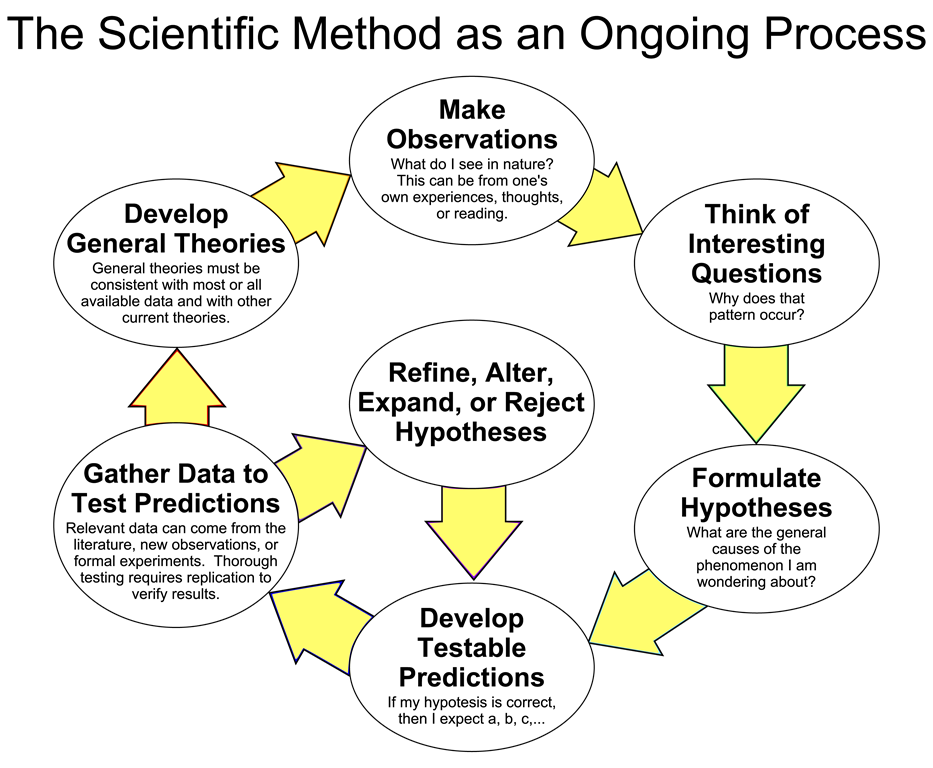
Basically, the scientific method is a methodology or procedure, if you will, where the simplified process goes something like this:
- Observe the problem or a situation – we see something in nature which we cannot explain, for example.
- Wonder ‘WHY?’
- This means that both the problem and our goal were defined: something is happening, and we want to know why.
- Think about a HYPOTHESIS – a possible explanation.
- This is happening BECAUSE …
- NOTE! The Hypothesis is NOT necessarily correct. It might be completely REJECTED in the next steps and then replaced by a different hypothesis.
- The Hypothesis must be TESTABLE. This means that scientists must be able to test whether this explanation is true by seeing whether its predictions about the world hold. By this definition, things outside nature are not testable.
- IMPORTANT! The Hypothesis must be FALSIFIABLE, meaning scientists can DISPROVE it through an experiment. This means that scientists need to be able to imagine and perform an experiment which might disprove that Hypothesis. By the very definition of the scientific method, hypotheses must be testable; for example, the idea that fairies sometimes save people from car crashes cannot be tested.
- What this all means is that a successful hypothesis has withstood attempts to disprove it and has not been disproven by experiments.
- Make a prediction – define what the CONSEQUENCE of prediction being correct is – if the Hypothesis is correct, this means …
- Another way of saying this would be – what should the results of an experiment be if a hypothesis is correct?
- These predictions must be repeatable, meaning they cannot be explained by random chance. Scientists need to be able to repeat the experiment and obtain the same result.
- This is where the falsifiability comes in – if these predictions do not occur, or experiments show a different result, this would mean that the Hypothesis is incorrect. It must be possible to get a negative answer.
- What follows from this is that when a prediction is not falsified, this contributes to the validity of the Hypothesis, making it more credible.
- TEST the predictions – the most important part.
- Perform experiments to test whether the predictions hold. This means that scientists check whether observations from an experiment agree with the Hypothesis’s prediction.
- The important thing is that the experiments are also RISKY to the Hypothesis. It makes no sense to perform experiments directly designed to confirm the Hypothesis. In essence, scientists are trying to falsify it.
- Here, additional steps are taken to mitigate the bias of individual scientists. One of the most important concepts is, for example, a double-masked trial, in which neither the subjects of the experiment nor the scientist conducting the experiment know the variables that can affect the testing, meaning the scientist cannot influence the results. This is mostly used in testing of the drugs, where neither those who administer the test nor the test subjects know which pills are the placebo and which are the active ones
- ANALYZE the results of the experiments
- This means that, in some cases, scientists perform additional steps on the results of experiments, such as mathematical modelling.
- The results of the experiments are compared with the predictions made by the Hypothesis. Then a decision is made on what to do next. Experiments might have completely disproven the Hypothesis, for example. In this case, scientists would need to return to the third step and reconsider the Hypothesis – come up with a new one.
- It is also possible that scientists decide they did not perform enough tests. In this case, they need to test another prediction of the same Hypothesis and see if this holds up as well. Each successful test increases confidence.
- While in this manner it might not be possible to define what is true in the strictest sense of mathematical proof, for example, a hypothesis can indeed be proved beyond a reasonable doubt.
- Of course, scientists may get no solution at all after all the tests.
- Likely, one Hypothesis is simply a part of something bigger, in which case not disproving this particular Hypothesis does not mean anything HUGE in the great scheme of things. Still, scientists build on this to the next Hypothesis that might follow.
- A few tested hypotheses can, for example, form a theory.
- A theory is “a well-substantiated explanation of some aspect of the natural world that is acquired through the scientific method and repeatedly tested and confirmed through observation and experimentation.” – Wikipedia.
- Theory can also contain facts – facts are observations that have been confirmed and are regarded as true.
It is important to note that, in modern Science, this rigorous process is repeated over and over again because the best hypotheses enable scientists to build on them.
But wait, that’s not all. There is also another layer called peer review.
Peer Review
So, after (or before, during the research-grant phase) interpreting the data and publishing results, science magazines and those who give grants for research have a peer review policy, but in theory every single step of the scientific method is potentially subject to the peer review. [Wikipedia – Elements of the scientific method] This means that the work, (data or publication) is given to the peers, or colleagues of the scientists who are making the hypothesis or publishing the paper. These other scientists who work in the same field independently review the work and provide the feedback which can get scientific paper published or not published. The scientists who originally thought about the hypothesis might be given a possibility to review the publication and try to submit it again. For example, highly acclaimed scientific journals Science and Nature only publish about 7% of all papers submitted to them.
So, it’s not easy to get even funded or published.
After publication
When the paper is published, even this is not the end. That makes it accessible to the larger scientific community as a whole, meaning any scientist can see for themselves the specified paper, data, and analyses. Beyond peer review, any scientist can now try to refute the paper’s claims. Not every scientist goes through every paper, OF COURSE. Still, the old saying goes that nobody would like more than to prove they are smarter than their colleagues, so even if something suspicious got through the method and peer review, it can still be exposed to scrutiny and proven wrong.
Take evolution, for example. It has been around for a long, long time, available for all to try and dispute it. They have the data, they know what would dispute it. Nobody ever has.
Conclusion
So, it should be clear that Science is not exactly joking around when it comes to being methodical and rigorous with its ideas and conclusions. Any attempt to compare this rigorous process with any other alternative explanation of the facts of the Universe should convince you that Science is more trustworthy than gurus who say we have chakras inside us, or astrology, or organic foods, or almost any new-age spiritual thing. New-age spiritual things are more or less fine when it comes to things that aren’t so important, such as entertaining yourself with stories about healing crystals, but putting your actual health in anything less than this rigorous process seems really, really foolish. Same goes for horoscopes, homeopathy, etc..
Of course, you should think for yourself. Nobody ever suggested otherwise. But when trying to conclude something, the only evidence you should be looking at is scientific evidence. If a suggestion you think might be true has some merit, it should be possible for you to find other scientific studies that say something different. For example, if you are trying to conclude gravity, you should not listen to the gurus who might say gravity is not real because they don’t feel it in their heart, but look for a scientific refutation of gravity. No other opinion even comes close.
Sources and further reading:
- Scientific method on Wikipedia
- What is Peer Review in Science? on Study.com
- Peer Review in Scientific Publishing on Visionlearning
- Prediction in Science on Wikipedia
- Scientific method on RationalWiki
- How Scientific Peer Review Works on HowStuffWorks
- Definitions of Fact, Theory, and Law in Scientific Work at the National Centre for Science Education
- Introduction to the Scientific Method at the University of Rochester
- Research on Wikipedia

Comments