

Where I Stand
I’ve been thinking lately about how many people seem to hold their beliefs the way you’d hold a team jersey — loosely, automatically, without ever quite asking why it ended up on their body. Religion, politics, ideology, the cluster of opinions you’re supposed to have if you also have these other opinions. People wear it all without checking the fit.
I don’t want to live like that. I want to know what I think, and more importantly, why I think it. So I’m starting a series of posts where I try to lay myself out honestly — not to convince you of anything, but in the hope that watching me do it might make you want to do the same for yourself.
Let’s start somewhere uncomfortable.
I’m a straight white man. I am also a Feminist.
A decade ago, writing that sentence felt like stepping into a culture-war minefield. Today, it feels almost quaint — the discourse has moved on, in the sense that it’s fragmented into a hundred smaller arguments, and most people are tired of all of them. But the underlying thing the word privilege was pointing at hasn’t gone anywhere, even if the word itself has been beaten into uselessness by overuse on one side and bad-faith eye-rolling on the other.
So I want to try to say something honest about it, without the slogans.
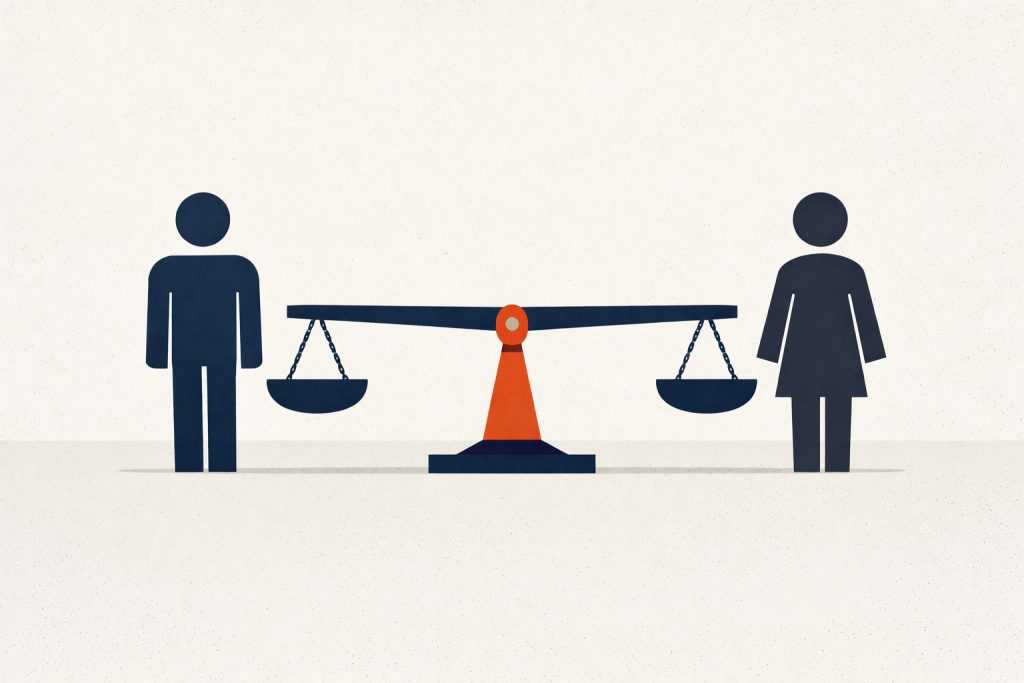
Here’s what I actually think: being a straight white man, where I live and in the world as it currently exists, is statistically the demographic least likely to encounter friction because of who you are. Not because of what you’ve done, or what you believe, or how you behave — just the baseline fact of you. That’s it. That’s the whole claim. It’s not a moral indictment; it’s a description of how doors tend to open or stick.
I know some men hear this and immediately reach for the counter-evidence: their hard childhood, the job they didn’t get, the relationship that fell apart, the way nobody seems to care about male loneliness or male suicide rates. And those things are real. I’m not dismissing any of them. Every person is fighting some battle you can’t see, and being a straight white man doesn’t exempt you from any of the ordinary human griefs — work, family, love, money, meaning, the body breaking down, the slow accumulation of regret. None of that is on sale just for you.
But there’s a difference between having problems and having problems specifically because of who you are at the level of skin and gender and who you sleep with. That second category is the one I don’t have to think about much. I can travel through most countries without my passport causing problems. I can speak up in a meeting and be heard as someone with an opinion rather than as a representative of my whole demographic. I can walk home at night without doing the mental math women do automatically. When I’m frustrated or angry, no one reads it as a referendum on my entire group.
That’s what people meant by privilege, before the word got mangled. Not “you were born rich.” Not “your life is easy.” Some categories of friction don’t apply to you, and you can spend the energy elsewhere.
I think the thing that’s changed since 2017 or so is that we’ve all had a long time to watch this conversation play out badly. We’ve watched people use privilege as a conversational trump card to dismiss anyone they disagree with. We’ve watched men respond to the word as if it were an accusation of personal evil rather than a description of structural averages. We’ve watched both sides perform their roles so reliably that the original observation got lost. And in the meantime, the actual numbers — who runs the companies, who writes the laws, who gets the loan, whose pain registers as a problem worth solving — haven’t shifted nearly as much as the volume of the conversation would suggest.
So when I say I’m privileged, I’m not flagellating myself or apologising for existing. I’m just trying to be accurate. I didn’t earn the parts of my life that came from the demographic lottery, any more than anyone earns being born tall, born into a stable country, or born with a working pancreas. Those are starting conditions. What you do with starting conditions is the actual moral question.
And that’s the part I find more interesting than the labelling, honestly. Once you accept that you’re starting from a slightly easier position — not a guaranteed-victory position, just an easier one — you get to ask a more grown-up question: what do I want to do with that?
You can hoard it. You can pretend it doesn’t exist. You can spend your life resentful that anyone noticed it. Or you can use the fact that doors open more easily for you to hold them open for other people. You can use the fact that your voice carries to amplify those that don’t. You can stop treating “privilege” as an attack and start treating it as a tool you’ve been handed, like it or not, that you now have to decide how to use.
I don’t think this makes me virtuous. I think it makes me, at best, honest about the situation I’m operating in, which feels like the minimum requirement for writing the rest of these posts — because if I can’t be honest about something this basic, I’m not going to get anywhere on the harder questions about what I actually believe and why.
So: that’s one true thing about me. More to come.


Comments