

The thing nobody tells you about becoming a feminist as a man is that the day-to-day reality of it is much smaller and much less heroic than the word suggests. There is no induction. There is no oath. Nobody hands you a manual. You start noticing things, and once you have noticed them, you cannot really un-notice them, and the noticing slowly reorganises how you behave in ordinary rooms.
I want to write about ordinary rooms because most of what gets written about feminism is pitched at the level of policy, theory, or the latest Argument someone is having on the internet. Those things matter. But they are not where most men live. Most men live in meetings, dinners, group chats, and conversations with their partners and their kids, and the habits that govern those small rooms are the ones that actually move the needle. If feminism cannot reach you there, it cannot really reach you.
So this is a post about what I think feminism asks of me in the small rooms. Not what it asks of the movement, or of governments, or of other people. Just me, and by extension any man who has worked out that the position is correct and is now wondering what to do.
Listen before you explain.
The single habit that has changed the most for me is the order of operations when a woman describes something that happened to her. The old order was: listen, evaluate, respond. In practice, this meant listening for about as long as it took to form a counterargument, then deploying it. Was she sure that was what he meant? Could it have been a misunderstanding? Was she perhaps being a little sensitive?
The new order is simpler. Listen. Then, if a response is wanted, ask what kind of response is wanted. Sometimes the answer is I want your opinion, in which case you can give it. More often, the answer is I want you to hear me, in which case the helpful thing is to have heard. The amount of friction this has removed from my relationships is genuinely embarrassing in retrospect, because the fix was so cheap and I resisted it for so long.
The deeper move under this habit is recognising that when a woman describes something, she has usually already done the analysis. She has run the “was I overreacting?” check, the “could it have been innocent?” check, the “am I being unfair?” check, probably several times, probably before she opened her mouth. When you arrive late to the conversation with those same checks, you are not adding rigour. You are asking her to defend a conclusion she already audited without you. That is exhausting, so the women in your life stop telling you things, which is, eventually, its own kind of loss.
Notice who is being interrupted
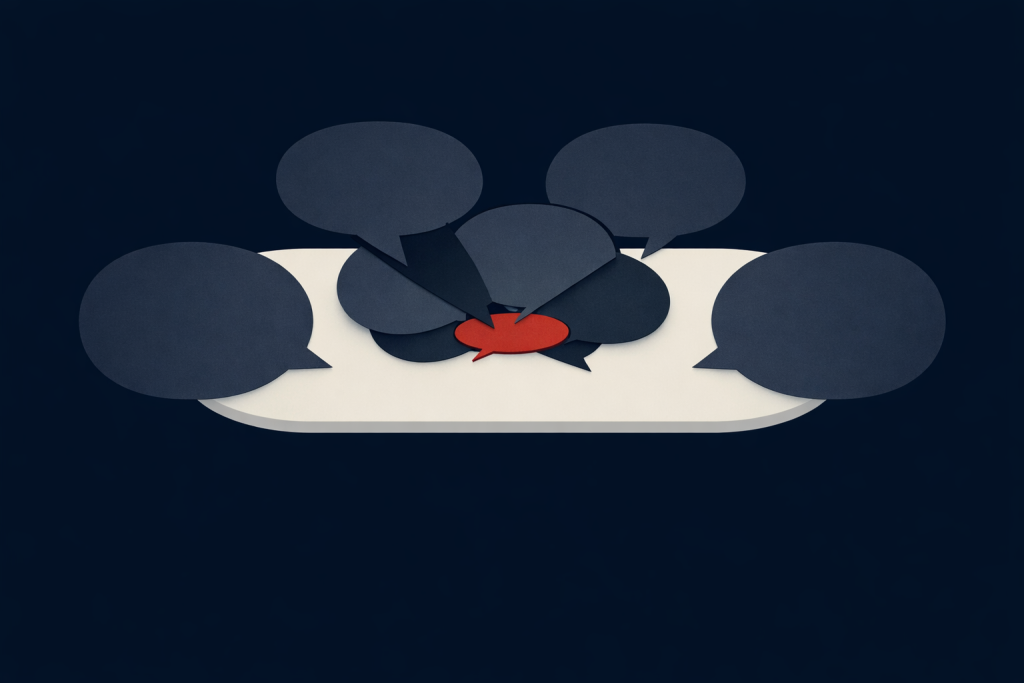
I used to think meetings were basically meritocratic. Whoever had the best idea spoke up, whoever spoke up got heard, and the result was roughly the average of the ideas in the room. This is not what meetings are. Meetings are a competition for airtime, with unwritten rules that systematically favour whoever is loudest, most confident, most willing to interrupt, and most certain that an interruption will not cost them anything socially.
That last bit is the part most men miss. Interrupting is cheap for me. It is not cheap for everyone. A woman who interrupts at the same rate as the men in the room is read as aggressive; a woman who waits her turn often does not get one. Either she pays a social cost for participating, or she pays a participation cost for being polite. The men in the room rarely pay either.
What feminism asks of me here is small and concrete: notice who keeps getting cut off, and do something about it. Hold on, I want to hear the rest of what she was saying. Sorry, I think you were in the middle of a point. You do not have to be the chair. You do not have to make a speech. You have to be the one person in the room willing to spend a tiny bit of social capital to restore the flow after an interruption, and you will find that the cost to you is roughly zero and the benefit to the conversation is substantial. After a while, it becomes automatic. After a while, you start noticing it everywhere, and you wonder how you ever found meetings boring; they are riveting once you can see the pattern.
Stop laughing at the joke.

The joke is the load-bearing wall. It is the thing that keeps a lot of bad attitudes structurally sound, because the joke lets people deny that they meant the bad attitude while still circulating it. I was kidding. Can’t you take a joke? It’s just banter.
I laughed at a lot of jokes I shouldn’t have. Not because I agreed with them. Because laughing was the path of least resistance, and not laughing required either a confrontation I did not want or an awkward silence I was not willing to sit in. The laugh was a small thing. The cumulative effect of a lot of small things was that the men around me were never given any signal that the jokes had a cost.
You do not have to give a speech. You do not have to ruin the dinner. You cannot just laugh. You can let the silence happen. You can change the subject. You can, if you have the energy, say something mild — eh, I don’t know about that one — and let the mildness do its work. The point is not to be the comedy police. The point is that the people who tell those jokes are running a constant survey of the room, and as long as you are laughing, the survey comes back, the room is fine with this. Stop returning that result, and the surveys come back differently, and the jokes change, and the attitudes underneath them slowly stop being structurally sound.
This one took me longer than it should have because I valued being seen as fun more than being seen as having a spine. Both can coexist. But if you have to pick, pick the spine. You will lose some company you should have lost anyway.
Raise the kids without the script.
The thing I want to do differently is to throw out the gendered script for what a kid is allowed to feel.
The script, in case you have forgotten it: boys do not cry, do not need comfort, do not get to be afraid, do not get to be soft, do not get to admit when they are hurt. Girls do not get to be angry, do not get to be loud, do not get to take up space, do not get to want things directly without softening the want. The script is so ambient that you can follow it without realising you are following it, just by mirroring back to the kid what was mirrored back to you.
What feminism asks of a parent is to notice the script and refuse to read from it. Let the boy cry. Let the girl be angry. Let both of them have the full range of human emotion that you, as an adult, have spent half your life trying to recover access to after it was trained out of you. The recovery is hard. The not-losing-it-in-the-first-place is much easier. You can give your kids that. It is one of the larger gifts on offer in this whole project.
Vote like they are not abstractions.
The political part of this is the part I find easiest to write about and hardest to actually do, because it requires sustained attention to issues that are not personally inconvenient to me. The women in my life are dealing with policy in ways I am not. Reproductive rights. Workplace protections. Healthcare that takes their symptoms seriously. Legal recourse when something happens. The whole apparatus that determines whether a problem they have is one the state will help with or one they have to solve alone is voted on by people like me. People like me have, historically, voted as if these were marginal issues.
They are not marginal. They are central to whether the women you love can live the lives they want to live. The least a man can do — and I mean the actual minimum, the floor — is to vote in a way that treats those issues as if they were happening to him. Because in the relevant sense they are. The world your partner lives in is the world you live in. The world your daughter will inherit is the world your son will inherit. There is no version of this in which the women you care about lose, and you somehow do not.
This is not a complicated ask. It does not require activism. It requires paying attention long enough to know what is actually on the ballot, and then voting accordingly. You can do it in twenty minutes a year. The men who refuse to do it usually refuse because the refusal feels like loyalty to some other tribe, not because the twenty minutes are hard.
The point of all this
None of these habits is heroic. That is the point. The version of feminism that gets argued about online is the version where everything is a battle, and everyone is shouting, and the stakes feel impossibly high. The version that lives in actual rooms is much quieter. It is mostly about being slightly more attentive than you used to be, in moments that used to slide past without your noticing.
The reason this feels like a lot when you first start doing it is that the previous default — not noticing — was very comfortable. Comfort, once you have had it, is hard to give back. You will catch yourself reaching for it. You will catch yourself wanting to laugh at the joke, or interrupt the meeting, or skip the analysis and jump to the rebuttal. The work is noticing the reach and not following through. Over time, the reach itself gets weaker. After enough time has passed, you forget that you used to do it.
That is most of what feminism has asked of me. Not a lot. Just enough that it adds up.
This post was written with AI assistance.




Comments