
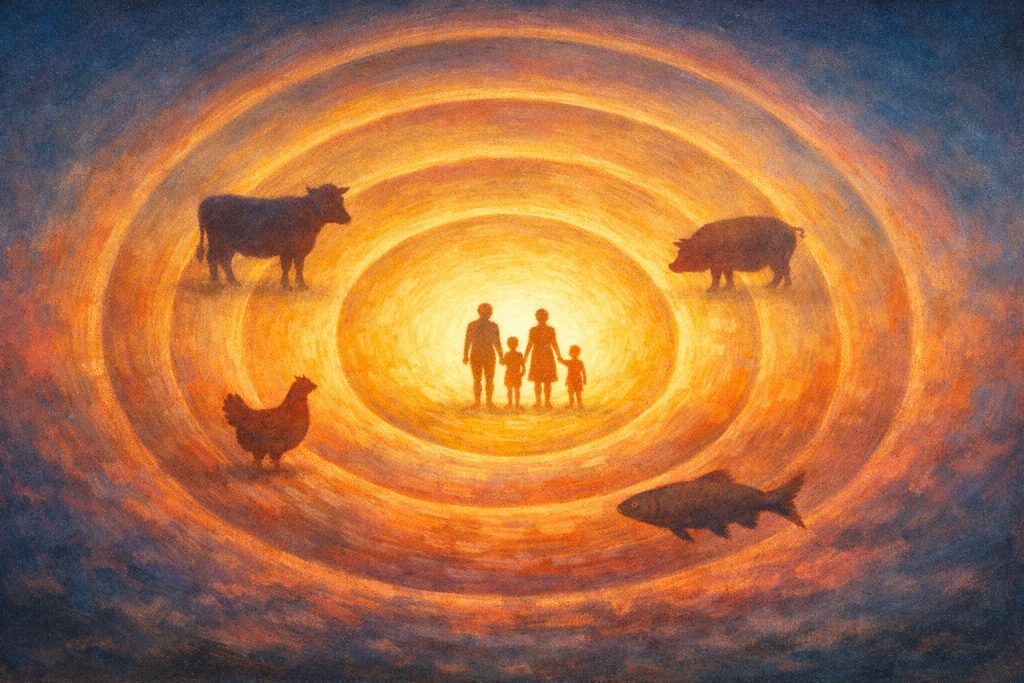
TL;DR — We already refuse to farm profoundly cognitively disabled orphans, and we’re right to — but no capacity, no species membership, and no web of relationships explains why without collapsing into arbitrariness. The one property that survives every test is sentience: a life that goes well or badly for the one living it. That’s exactly what we share with the pig, so the reason we protect the orphan is a reason that reaches the animal. The circle has to widen — and what it protects against is killing, not merely suffering: a painless death wouldn’t make farming the orphan permissible, so it doesn’t for the animal either. Consistency, not sentiment, is what commits us.
I want to start not with an animal but with a person.
Imagine a human being with a profound cognitive impairment — someone whose mental life, through no fault or choice of their own, never developed past what we might, without cruelty, call the level of a bright animal. No language, no long-term plans, no biographical sense of a self stretching into the future.
Now suppose this person is an orphan. No family who loves them, no friends who’d miss them, no one who’d grieve. They exist, they can suffer and feel comfort, and beyond that, they are, in the ways we usually count, alone.
Here is the question the rest of this post hangs on: why is it monstrous to farm this person for food?
Not whether it’s monstrous. It obviously is. The question is what makes it so — and I think if you follow that question honestly, it takes you somewhere you might not want to go, and won’t let you off until you’ve either changed how you eat or admitted something uncomfortable about why you don’t.
The simplest reason anything matters
Let me put the foundation on the table first, because everything rests on it and almost no one disputes it.
The reason it’s wrong to hurt the orphan is not their intelligence — they don’t have much. It’s that they can suffer. They have a life that can go well or badly for them; there is someone at home for whom things matter. That capacity — sentience, the ability to have experiences that are better or worse from the inside — is the thing that generates a moral claim in the first place. A rock has no stake in how it’s treated. A being that can suffer does.
This is the least controversial starting point in all of ethics. You don’t need a theory to feel it; you need only to have once been in pain and known, without argument, that it was bad. And it is the doorway into the whole question of animals, because the moment you grant that suffering is what matters, you’ve granted that the capacity to suffer is what counts — and you’ve said nothing yet about species.
Hold onto that. We’ll find that the door, once opened, leads further than the people who open it expect.
The criterion that isn’t there
Back to the orphan. The instinctive answer to “why is farming them monstrous?” is that they’re human, and that’s enough. But press on it. What is it about being human that does the work?
The usual replies name capacities: rationality, language, self-awareness, the ability to reciprocate obligations, and a sense of one’s own future. Each is a real and morally interesting thing. And each has the same fatal flaw when you try to make it the wall between the animals and us — the problem philosophers call the Argument from marginal cases.
Whatever capacity you name, there are human beings who lack it. Infants lack rationality and language. People in the last stages of dementia have lost the biographical self. And the profoundly disabled orphan lacks most of the list from birth. Yet we would never dream of farming them. So either the capacity you named isn’t really what grounds full moral protection — or it is, and you’ve just licensed the unthinkable for a whole class of humans.
Almost no one will take the second option. Which means the capacity was never doing the work. What’s left holding the line is bare species membership — the fact of belonging to Homo sapiens — and that, on inspection, is a strange thing to build a moral universe on. It’s structurally identical to the moves we’ve learned to distrust everywhere else: privileging a group because it’s our group, on no ground but membership itself. Peter Singer’s word for it is speciesism (see Peter Singer: Animal Liberation – Review), and the parallel to racism and sexism isn’t rhetorical excess — it’s the same logical shape. A preference for one’s own kind, dressed as a principle.
The ZigBlongs test
There’s a clean way to feel the force of this. Imagine a species far more cognitively advanced than us— call them the ZigBlongs— arriving on Earth. If the only thing standing between the disabled orphan and the slaughterhouse is species membership, then the aliens, who don’t share our species, would do nothing wrong in treating that person exactly as we treat a pig. Same capacities, same absence of a future-directed self, and now no shared species to invoke.
If that conclusion horrifies you — and it should — then species membership was never the real protection. It only felt like protection because we’re the ones who benefit from drawing the circle there.
Some try to rescue the line with relationships rather than species: the orphan is protected not by their capacities or by mere biology, but by their embeddedness in a web of human care. But this faces a dilemma it can’t escape. Either relationships are the genuine source of moral status — in which case the person’s standing is borrowed, held on their behalf by others, exactly like a beloved pet’s- which is a defence that demolishes the dignity it meant to protect. Or relationships merely trigger our recognition of a status the person already has — in which case we’ve slid back into species membership under a new name, and the alien test bites again. And the orphan finishes it off: strip away every relationship, and on any genuinely relational view, their protection vanishes — a result no one accepts. The reply has no stable place to stand.
What actually survived
So here we are. Capacity-based criteria fail. The relational rescue fails. And yet the conviction that we must protect the vulnerable human in full remains — utterly, rightly immovable.
What’s holding it up? Something closer to bedrock than to any tidy principle. And I’ll be honest: this bedrock isn’t cleanly grounded in any theory, including the one I’m defending — everyone in this Argument is leaning on it. The question is not whether to lean on it, but whether we honour it consistently.
Because look at what survived every test. Not intelligence — the orphan has little. Not species — that was arbitrary. Not relationships — those failed. The one property left standing, the thing our protection was actually tracking all along, is the property we started with: the capacity to suffer, to have a life that goes well or badly for the one living it. Sentience.
And sentience is not unique to us. It is precisely what we share with the pig.
Sentience is the ability to experience feelings and sensations. It may not necessarily imply higher cognitive functions such as awareness, reasoning, or complex thought processes.
This is the whole Argument, and it is a consistency Argument, not a sentimental one. I am not claiming the pig matters as much as you do, or that a cow’s life weighs the same as a child’s. I’m claiming something narrower and much harder to escape: the grounds on which we already protect every human — including those who fail every capacity test — cannot be stated in a way that excludes animals without arbitrariness. So the circle we’ve drawn around our own vulnerability has to widen, not because animals are adorable or because we feel for them, but because the reason we protect the orphan is a reason that reaches the pig. Accept the premises you already hold, and consistency drags you outward.
And notice what that protection is. We don’t merely refuse to make the orphan suffer. We refuse to kill them. The wrong we recognise is the ending of a life that is its own, a life with someone inside it for whom things matter. That is the protection the circle carries. When it widens to the animal, it carries the same content: not just a claim against pain, but a claim against being killed.
The exit I won’t take
There is another way to resolve the inconsistency, and honesty requires me to name it. If the orphan and the animal are morally alike, you can level up — extend real protection to both — or level down and limit what we owe the disabled. Logically, the second exit is open.
I won’t take it, and the reason isn’t squeamishness. The intuition protecting vulnerable humans is one of the most secure things in all of ethics — far more secure than the abstract premises any Argument would need to overturn it. When a conclusion is less credible than the conviction it asks you to abandon, the rational move is to reject a premise, not the conviction. And the stakes are not symmetric: level up and the worst case is that you are too generous to animals; level down, and you’ve licensed the mistreatment of beings who cannot speak for themselves — a road whose historical signposts all point somewhere unspeakable. “Their capacities are really more like an animal’s” is not a novel insight. It is the oldest machinery of atrocity there is. So the inconsistency resolves upward, or it doesn’t resolve honestly at all.
You might reach for one last escape: maybe the protective intuition is just an evolutionary artefact — kin-loyalty misfiring, not moral perception. Perhaps. But that acid dissolves too much. Our sense that suffering matters at all is equally a product of evolution; debunk one and you debunk the other, and the whole case against cruelty goes with it. And run carefully: the debunking cuts the other way, because the intuition with the cleanest evolutionary story is – favour your own, discount the outsider. The thing evolution most obviously built into us is speciesism. The widening of the circle is the part we reach by correcting against our instincts, not the part they hand us.
“But what if it didn’t suffer?”
Here is where the honest interlocutor speaks up — and I want to take them seriously, because they’ve come further than most. They’ve granted the whole Argument. They accept that suffering is what matters, that the animal is inside the circle. And they say: fine. Then raise the animal well and kill it painlessly, without fear. Remove the suffering, and haven’t you removed the wrong?
This is a real question, and it deserves a real answer rather than a brush-off. But notice what it quietly assumes: that suffering was the whole of the animal’s claim. That once no pain is felt, nothing is left to object to.
We can test that assumption directly, because we’ve already met a being it applies to. Return to the orphan. Suppose the killing were painless — swift, fearless, no suffering of any kind. Is it now permissible to farm them?
Of course not. The wrong was never only the pain. The wrong is in the killing — the extinguishing of a life that was its own, a being for whom things could still have gone well. Suffering makes it worse; suffering is an aggravation. But its absence does not make killing permissible, or we’d have licensed the painless slaughter of the orphan, which we plainly haven’t.
The circle already answered this. It protects the animal the way it protects the orphan — against being killed, not merely against being hurt. So the painless-killing move, taken honestly, doesn’t touch the Argument at all. It concedes the circle and then mistakes the doorway for the whole house: it treats suffering, which was only our way in, as if it were the entire content of what we found inside.
And then — only as a second, lesser point — there is the matter of the real world. Even someone who rejects everything I just said, who insists a painless death would make the meat permissible, still cannot have what they want, because that meat does not exist. The animal raised without fear and killed without suffering, on the scale we actually eat, is essentially nowhere on the shelf. So the defence fails twice: in principle, because the circle protects against killing; and in practice, because its own conditions are never met. The first failure is the real one. The second is merely the lock on a door already closed.
The honest take
I should concede one thing, because you’re probably feeling it. Even granting all of this, common sense insists that killing the orphan is worse than killing the animal — and I think common sense is probably right. More is destroyed: a richer life, more of a world, more that could have been. But notice two things. First, “worse” is not “permissible.” A lesser wrong is still a wrong; the animal’s death mattering less does not make it matter not at all, any more than a smaller murder is a murder.
And second — how much worse is exactly the judgement our instincts are least to be trusted on, because the felt distance between the near and the far is precisely where our parochialism hides. The gap is likely real. It is also likely smaller than it feels. And being willing to interrogate that gap — to ask whether the weight we assign is tracking the being’s stake or merely its resemblance to us — is not a footnote to expanding the circle. It is expanding the circle. The widening isn’t only about who gets in; it’s about auditing how much each one counts once they’re inside.
What this asks of us
So what does the widened circle demand at the dinner table?
Start with the sharpest distinction, because it does most of the practical work. For meat, the harm is intrinsic to the product. Death is not a by-product you can engineer away — death is the thing. There is no version of eating the animal that does not require killing the animal. For milk and eggs, the harm is contingent on the method. The industrial default is genuinely cruel, but the suffering is a fact about the industry, not about the product — and lower-suffering options really do exist, can be sought out, and can be bought.
That asymmetry is what draws the line, and it draws it at flesh. Apply the same real-world test to both — the very test that sank the painless-meat defence — and it lands differently on each: no-suffering meat is essentially unavailable, while genuinely lower-suffering dairy and eggs are findable, real products. Meat is unrescuable; animal products are conditionally rescuable.
So the honest minimum this argument commits us to is trying to become vegetarian — not as a compromise short of where the logic goes, but because the logic itself falls hardest on flesh. Veganism is the better goal: the suffering in dairy and eggs is real, and the argument goes further. But it isn’t realistic to ask most people to arrive there in a single step, and low-suffering sourcing on the products that can be rescued is a genuine path in a way that humane meat at scale simply is not. Vegetarianism is the categorical floor. Veganism is the horizon.
And this is a journey, not a threshold you clear or fail. Every reduction is a real moral win — not a gesture that lets you off, but a step in the right direction, and the fact that you cannot reach the end is no reason to refuse the first step. All-or-nothing thinking is mostly just how people talk themselves into doing nothing at all.
A confession, and what it isn’t
I don’t fully live by this. I still eat meat sometimes. I don’t meet even the vegetarian floor I’ve just argued is the minimum.
I’m telling you that plainly, and I want to be equally plain about what it does and doesn’t mean. It is a fact about me, not a flaw in the Argument. I find this reasoning genuinely hard to escape — I don’t see how to reject its premises without giving up things I hold far more firmly — and my failure to fully act on it is a gap in my conduct, not a crack in the reasoning. Don’t read my inconsistency as evidence that the bar is unreasonable. The Argument stands exactly where it stood before I admitted I fall short of it. I’m the one lagging behind, and I’d rather show you the whole thing, unflattering to me, than wait until I’m worthy of it to speak.
The line we can’t draw between ourselves and the animals turns out to be the same line we can’t draw between ourselves and our own most vulnerable. We already know we won’t abandon them. Consistency asks only that we mean it.
Written with AI assistance.



Comments