
If you have spent any time online in the last few years, you have seen the arguments about gender: the videos, the threads, the memes. Most of them generate more heat than light. One side treats the whole topic as self-evident; the other treats it as self-evidently absurd — “they’re saying there are 274 genders now” — and considers the matter closed.
I don’t think either reflex survives contact with the actual question. So this post tries to do something narrower and, I hope, more useful: lay out what people mean when they distinguish “gender” from “sex,” why that distinction was drawn in the first place, and where the honest disagreements actually are. I’ll make the case for the distinction as clearly as I can — and then put the strongest objections to it in their strongest form, because a claim you’ve only seen defended is a claim you don’t yet understand.
Biological sex
Start with the part almost everyone agrees on. Sex is the set of biological properties — chromosomes, hormones, gonads, reproductive anatomy — that sort humans into male, female, and a small number of intersex configurations. The World Health Organisation puts it plainly: sex refers to “the different biological and physiological characteristics of females, males and intersex persons, such as chromosomes, hormones and reproductive organs.”
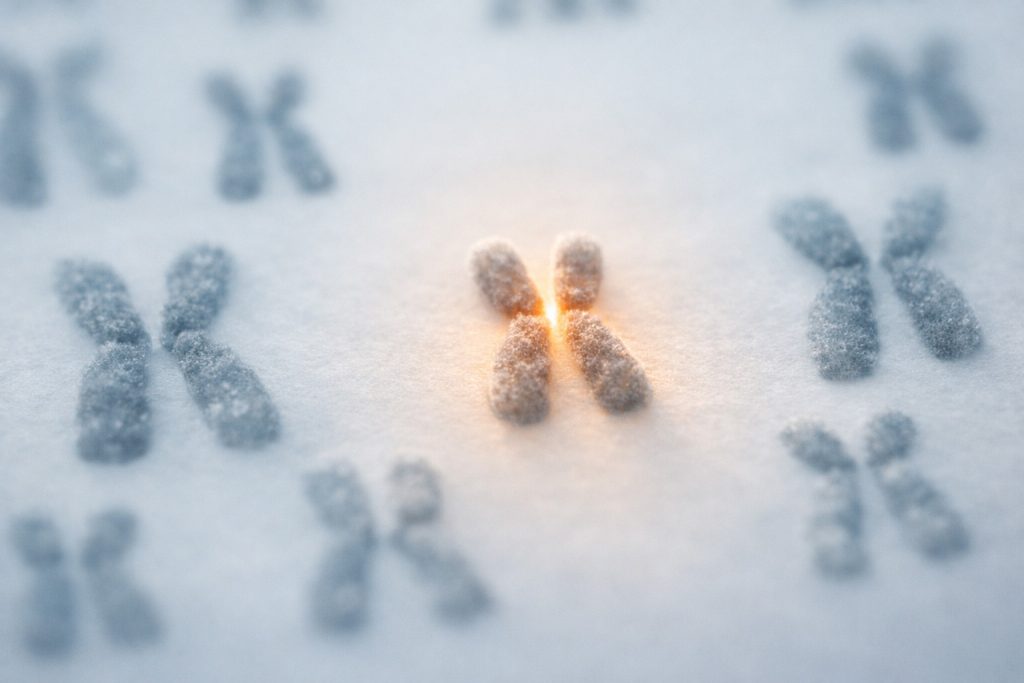
Humans typically have 46 chromosomes in 23 pairs, with the X and Y pair associated with sex: most females are XX, most males XY. But the system has edge cases — XXY, XYY, XXX, single-X — and conditions such as 45,X/46,XY mosaicism where anatomy can be ambiguous. Intersex people, in the words of the UN human rights office, are born with characteristics that “do not fit typical binary notions of male or female bodies.”
Here I want to be careful, because this is where the original version of this post — and a lot of writing on this subject — quietly cheats. It is tempting to say: “See, sex isn’t a clean binary either; therefore, gender is separate.” That inference does not work, and it’s worth seeing exactly why before going further.
Intersex conditions are rare, and more importantly, they are a fact about bodies. They show that the biological categories have fuzzy edges. They do not, on their own, show anything about whether there’s a further thing called gender, distinct from sex, that applies to the roughly 99% of people whose bodies are unambiguous. The existence of borderline cases in a category doesn’t establish the existence of a second category. So if the distinction between sex and gender is worth drawing, it has to be earned by a real argument — not smuggled in on the back of intersex biology. Let me try to earn it.
Why draw a second line at all?
The reason “gender” exists as a separate word is not that sex is blurry. It’s that a lot of what we associate with being a man or a woman is demonstrably not biological, and we need vocabulary to talk about it.
Consider what varies. Whether pink is a “girl’s colour” (it was marketed as a boy’s colour a century ago). Whether women can hold property, vote, or drive. Whether nursing or engineering is “men’s work.” Whether men may cry in public. None of these track chromosomes. They track the place and era. A trait that a Victorian Englishman, a modern Swede, and a pre-contact Samoan would each sort differently is not fixed by biology — it’s fixed by society. That socially assigned layer is what “gender” names. The WHO definition captures it: gender refers to “the characteristics of women, men, girls and boys that are socially constructed,” and as a social construct it “varies from society to society and can change over time.”
So the first, modest claim is this: there is clearly a socially constructed layer of “manhood” and “womanhood” sitting on top of biological sex, and “gender” is the name for that layer. You do not have to accept anything about identity to accept this much. A conservative who thinks men and women should occupy different social roles is also talking about gender in this sense — he simply thinks the socially constructed roles are good and should be kept. The sex/gender distinction is not a progressive smuggling device; it’s just the observation that roles and bodies are two different things.
Some societies make this obvious by carving up the space differently from the way the West does. Samoa recognises fa’afafine and fa’afatama; Thailand has kathoey. I want to flag something the original post glossed over, because honesty demands it: these categories are often offered as evidence for the modern Western identity framework, but they don’t straightforwardly support it. Samoans, by many accounts, reject imported terms like “transgender” precisely because fa’afafine is understood as its own social role, not as an inner identity mismatched with a body. What the cross-cultural cases actually prove is the modest claim — that the social sorting of gender varies — not the stronger claims about identity we’ll come to next. Using them for more than that is overreach.
Gender identity — the harder claim

Everything above is relatively safe. The genuinely contested part is gender identity: a person’s internal sense of being a man, a woman, both, or neither — a sense that, for most people, aligns with their sex, but for some does not.
Here, I think the intellectually honest thing is to separate three claims that often get bundled together, because a reader can accept some and reject others:
- Some people experience a persistent, distressing mismatch between their sex and their internal sense of gender. This is well documented clinically — it’s the basis of the diagnosis of gender dysphoria, which the American Psychiatric Association’s DSM-5-TR defines as clinically significant distress arising from incongruence between one’s experienced gender and one’s sex assigned at birth, persisting at least six months. (Note the criterion is the distress, not the incongruence itself — the manual is explicit that gender nonconformity is not in itself a disorder.) It is about as close to established as anything in this area gets.
- That internal sense is a real phenomenon with partly innate roots, not mere preference, fashion, or ideology. I’ll say plainly where I land: I think the weight of evidence points to gender identity being something a person has rather than something they simply adopt, shaped by both biology and environment the way most deep human traits are. We don’t have a complete causal story — nobody does, for almost any complex trait — but “we lack a full mechanism” is not the same as “there’s nothing there.” We accept far less fully-explained phenomena as real all the time.
- How society ought to respond — pronouns, medical pathways, single-sex spaces, sport, care for minors. These are ethical and political questions, and they do not follow automatically from (1) and (2). You can accept that gender identity is real and innate and still weigh specific policies differently. That’s a feature of my position, not a hole in it: I’m defending a claim about what gender identity is, not a blanket endorsement of every policy flown under its banner.
Most online fights collapse these three into one and swing at the whole bundle. But they come apart, and separating them is the single most useful move available here. It’s also what lets me hold firm views on (1) and (2) while staying genuinely open to (3).
Answering the serious objections
A view worth holding should survive its best counterarguments, not just the memes. So here are the three objections I take most seriously — each stated as strongly as I can, and then answered. I’m not refereeing a debate between equal sides; I’m defending the position above and showing why I don’t think these objections defeat it.
“The whole thing is circular.” This is the sharpest objection, so take it at full strength: gender was defined as socially constructed roles, but gender identity is then defined as an inner sense of one’s gender — so the identity claim appears to smuggle in a second, essence-like meaning that the social-construction definition was supposed to exclude. If gender is just external social roles, how can there be an inner sense of it?
The objection is real, but it doesn’t cut where it thinks. The mistake is assuming “gender” must name exactly one thing. It doesn’t — and admitting so dissolves the circularity rather than deepening it. There is a social-role concept (what a society codes as masculine or feminine) and a felt-sense concept (one’s internal experience of being male or female), and they are related but distinct, the way “the law” as written statute differs from “the law” as one’s internal sense of justice. Once you name the two concepts separately, nothing is circular: a person can have an innate felt sense of being a woman and live in a society whose social roles for women are entirely constructed and variable. The felt sense isn’t derived from the social roles; it’s the thing the social roles get draped over. Far from being a weakness, this two-concept clarity is what the original debate lacks — most confusion here is just two ideas wearing one word.
“Sex still matters, so gender can’t override it everywhere.” Granting a social layer and an identity layer, the objection runs, there remain contexts — certain medical decisions, some athletic categories — where sex, not gender, is plainly the relevant variable. True. But notice this isn’t an objection to my position; it’s an implication of it. If sex and gender are genuinely distinct, then of course which one is relevant depends on context — a chromosomal question calls for the sex answer, a social-role question calls for the gender answer. The person insisting “gender always overrides sex, everywhere” has actually collapsed the distinction I’m defending, treating one layer as if it swallowed the other. My view predicts that sex is sometimes decisive. The objection, properly understood, is on my side.
“So how many genders are there — 274?” Strip away the sneer and there’s a fair question: if gender identity is an inner felt sense, and felt senses can be subdivided indefinitely, what stops the list from ballooning until every category names a single person’s personality? At that point the concept does no work.
The answer is that categories earn their existence by doing communicative and social work, not by how finely a feeling can be sliced. “Man” and “woman” are robust categories because enormous numbers of people cluster around them and organise their lives through them. A category that describes exactly one person isn’t wrong so much as useless — it has stopped being a category and become a description. So the honest answer to “how many genders” isn’t a number; it’s that the question misunderstands what a gender category is. We don’t ask “how many personalities are there?” and expect an integer. The vast majority of people fall into two large, stable clusters; a small number don’t; the interesting cases live at the edges — which is exactly what you’d expect of any real human trait, and not a reason to doubt the trait exists.
None of these, I think, lands a fatal blow — but they’re not strawmen either, and anyone who treats them as bigotry-in-disguise is both wrong and tactically careless. The way to win an argument is to answer its strongest form, which is what I’ve tried to do.
Why does any of this matter
One last point, and I’ll state it as what it is rather than as a lever. When a person’s felt gender is at odds with the role their family or society will permit them, the result can be real psychological harm. Among transgender and gender-diverse adolescents, systematic reviews consistently report markedly higher rates of depression, self-harm, and suicidal ideation than among their cisgender peers — and, importantly, the same literature identifies family support, school safety, and acceptance as protective factors that lower that risk (see this 2024 review in Child and Adolescent Mental Health and this scoping review). The usual caveats apply: these are largely clinical and observational samples, absolute prevalence figures vary widely between studies, and definitions of self-harm are not standardised. That’s a reason to take the topic seriously and to be humane in how we discuss it. It is not, by itself, an argument that any specific policy is correct; compassion sets the stakes, it doesn’t settle the questions. Conflating the two — “disagree with me and you’re causing suicides” — is exactly the kind of move that makes this debate worse.
Final thoughts
Like other posts here, this is a living document; I’ll revise it as my understanding improves.
What I’ve tried to do is separate the parts of this subject that are close to settled (there’s a social layer distinct from biology; some people experience a real, distressing mismatch) from the parts that are genuinely open (the causal story; the right policies) — and to give the objections their strongest form rather than their weakest. If someone reads this and still disagrees, I’d rather they disagree with the actual argument than with a caricature of it. The same courtesy is the least I can extend to them.
Further reading
- Gender (WHO)
- WHO — Gender and Genetics (archived)
- Intersex people (OHCHR)
- What is Gender? What is Sex? (CIHR)
- Gender fluidity: what it means and why support matters (Harvard Health)
A note on AI use: I wrote this piece with the help of Claude. The thinking, positions, and arguments are my own; I used AI as a tool for drafting, tightening, and refining the text. As always, the views expressed here are mine.



Comments