

Mapping the Manosphere


A young man is lonely. Not dramatically — just the ordinary modern kind. He works, he goes home, he scrolls, he sleeps. The weekends are quiet. Nobody has called him in a while, and he can’t remember the last time he called anyone either.
So he does what anyone does with an unpleasant feeling. He goes looking for a reason. And the internet has one waiting for him: fully formed, confident, sourced, and free.
The reason is women.
That’s the funnel. Not the alpha wolf stuff, not frame control, not the $49 course — those come later. The entry point is a real feeling and a ready-made cause. So I want to spend this whole post on the cause, because I think the manosphere is closer to right about the feeling than most of its critics will admit, and much further from right about the cause than its followers ever check.
Let’s give them the numbers.
I’m not going to fight about the statistics. Partly because I don’t need to, and partly because that Argument is where these conversations go to die.
So: yes. Men are lonely. The share of American men saying they have no close friends at all went from roughly three per cent in 1990 to around fifteen per cent by 2021 — a fivefold rise. Men are less likely to have someone to confide in, less likely to reach out when they’re struggling, less likely to ask for help. A lot of men in their twenties are single. Men die by suicide several times more often than women. All of that is real, and grifters invented none of it.
I’ll concede a step further. The mainstream response to men saying they feel alone has often been contempt, and contempt is not an Argument. If the only people willing to take a lonely man seriously are the ones selling him something, nobody gets to act surprised when he buys.
Numbers granted. Now look at what they actually say.
The one number that breaks the story
If men were lonely because of women — hypergamy, apps, feminism, whichever mechanism is in season — then men should be dramatically lonelier than women. That’s what the theory predicts. Gendered cause, gendered outcome.
It isn’t there. Ask men and women directly how lonely they feel and the gap more or less vanishes: Pew found about sixteen percent of men and fifteen percent of women reporting frequent loneliness. Researchers who dig into this keep finding that education and income predict loneliness better than gender does.
So the loneliness itself isn’t especially male. But something in the data is.
The friendship collapse is male. Men didn’t lose romantic access at some rate women didn’t. Men lost friends at a rate women didn’t.
That’s the post, really. The manosphere correctly noticed a hole in men’s lives, and then pointed at the wrong hole.
Where the friends actually went

Friendship runs on three unglamorous ingredients: proximity, repetition, and unplanned interaction. You have to be near the same people, often, in a setting nobody had to schedule.
Men’s friendships tend to be shoulder-to-shoulder — built around doing something rather than saying something. The team, the shift, the band, the Tuesday pub. That works fine; men in those friendships are genuinely close. But it has a specific weakness: it needs a venue. Remove the activity and the friendship usually goes with it, because the activity was the container.
And we’ve spent forty years quietly dismantling the containers. Sociologists call them third places — neither home nor work, somewhere you turn up often enough that familiarity happens by itself: clubs, churches, unions, leagues, the local. Most have thinned out badly, and nothing replaced them. Work absorbed some of the load for a while; then remote arrangements and job-hopping hollowed that out too. The tasks are still there. The standing around afterwards isn’t.
Every institution that used to host male friendship — school, team, workplace, parish, local — has either shrunk or stopped functioning socially. Each exit deletes a container. Nobody built new ones.
No woman did that.
A girlfriend is not a social life

Here’s where a friendship problem starts to feel like a mating problem.
When a man’s friendships evaporate, the need doesn’t. It gets rerouted and lands entirely on one person—who is now expected to be his best friend, his confidant, his therapist, his whole social life, and his only source of affection. If he’s single, the absence of a partner therefore feels like the absence of everything, because it is. So of course the loneliness presents as a dating problem. From the inside, it genuinely looks like one.
It’s also a historically new demand. Eli Finkel has spent years documenting how much more we now ask of a single partner than any previous generation did — we want a spouse to be a kind of life coach, not just a lover — and we ask it precisely as the surrounding structure that used to absorb most of those needs has disappeared. Nobody in 1950 expected their wife to be their only friend, because nobody in 1950 had only one friend.
Four things go wrong when you try it anyway.
One person can’t be six people. A group of friends gives you variety, not just volume — the one you argue about politics with, the one who helps you move a sofa, the one who knew you at nineteen and finds your current self hilarious. Nobody supplies all of that, however much they love you. Asking them to means being permanently, quietly disappointed by someone who is doing nothing wrong.
It removes your only outside view. Friends are a check on you. They’re the ones who say you’re being unreasonable, or drinking too much, or that the relationship you’re in is doing you harm. A man with no friends has nobody to give him an honest read on his own life, which means the only outside perspective available to him is whatever he’s reading online. That isn’t a side effect of this subject. That’s how the funnel closes.
It’s a single point of failure. If she leaves, or gets ill, or is just having a hard month of her own, the entire social infrastructure goes at once. And because the friendship recession hit men harder, she probably still has her network on the other side of a breakup, and he doesn’t. He didn’t lose a relationship. He lost everything simultaneously.
And it’s a burden, not a compliment. Being someone’s entire world sounds romantic for about a fortnight. After that it’s weight — the constant reassurance, the intensity nobody asked for, the inability to have an evening apart. The irony is exact: wanting a woman to cure your loneliness makes you substantially harder to be with, which is the very outcome you were told women were inflicting on you.
Which is where the last post landed, from the other direction. Having a life isn’t a trick for seeming more attractive. It’s what stops one person from having to be your entire life.
Both experiences get fed straight back into the same explanation anyway. She won’t date me. She left. She has options I don’t. The theory eats the evidence and grows.
Why the cure deepens the disease

Now take that man and give him the standard advice. Treat every interaction as a negotiation. Never show weakness. Assume other men are competitors for status. Watch your friends for signs of disrespect. Never be the one who needs something.
Ask honestly: is that a recipe for making friends?
It’s the precise inverse of the three ingredients. Proximity means showing up without an angle. Repetition means being reliable rather than impressive. Unplanned interaction means being relaxed enough to linger. The Red Pill tells a man to be strategic, guarded and competitive in exactly the situations where friendship requires him to be none of those. Followed properly, it produces a man with better discipline, better shoulders, and fewer friends than he started with.
And here’s the genuinely clever part. The manosphere does deliver something on arrival. The forum, the Discord, the podcast in his ears at the gym — that’s company. Men talking to men, taking his problem seriously, letting him belong. It relieves the symptom immediately, which is why it converts, and why nobody notices the medicine is the disease. He’s found a room full of lonely men, being taught the habits that keep them that way.
The boring fix
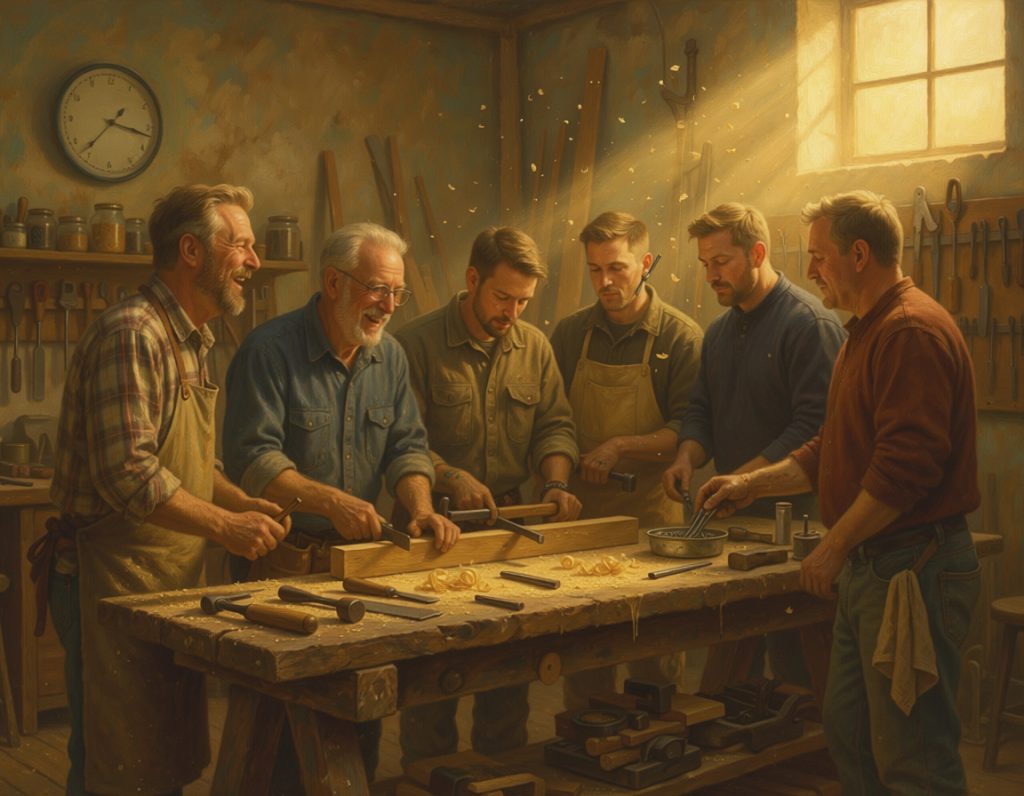
There’s no version of the answer that sounds impressive.
It’s a recurring thing. A standing night. Something with a schedule, other people, and a reason to show up that isn’t “I would like a friend.” Five-a-side, a climbing gym, a choir, a workshop, a D&D table, volunteering, a men’s shed. The activity matters far less than the fact that it repeats and the same faces are there.
Then the harder half: being the one who organises it. Sending the message and following up. Most men read initiating as neediness, so everyone waits and nothing happens. Someone has to text first. Might as well be you.
That’s the entire programme: no hierarchy, nothing to buy, no woman involved at any point.
The bottom line
The manosphere’s real trick isn’t wolves or frames or courses. It’s that it meets a man in genuine pain, takes him seriously when nobody else did, and hands him an explanation pointing away from anything he can actually change.
If you’re lonely, it’s very unlikely a woman did it to you. What happened is that the places where men used to become friends stopped existing accidentally, and nobody thought to tell you to find a replacement.
So find a room you have to show up to. Then keep showing up. It’s less exciting than becoming a wolf. It also works.
If any of this sits close to home: Telefonseelsorge is free and anonymous in Germany, and Find A Helpline lists the equivalent everywhere else.
Written with AI assistance.





Comments