

Going Digital

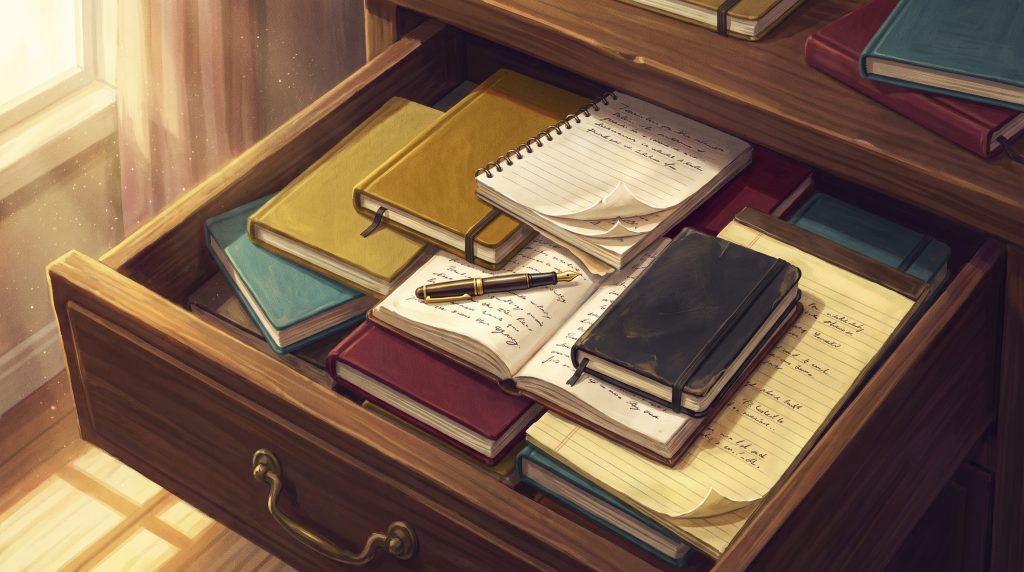
You probably own a notebook you like. Good paper, a pen that feels right in your hand, the small pleasure of a page filling up. And you probably own three or four of them that are half full, sitting in a drawer, holding thoughts you will never read again.
That second part is the interesting one. The question isn’t which surface feels better to write on — paper wins that easily, and pretending otherwise is silly. The question is what happens to the writing afterwards.
Capture versus retrieval
Paper is excellent at capture. It’s slow enough to think in; it doesn’t autocomplete your sentences, and it can’t interrupt you. Digital is excellent at everything that comes after capture: finding, connecting, revisiting, reusing.
That’s the standard framing, and it’s mostly right. But it hides a condition that turns out to do enormous work: paper only wins at capture when it’s actually with you.
Availability beats quality
A paper habit sits on top of a second habit. Before you can write anything, you have to have remembered to bring the notebook. Two habits fail more often than one.
And remembering isn’t even sufficient. Frequently there is nowhere to put it — a jacket with no inside pocket, a small bag, gym clothes, a day when you’re travelling light. A legal pad never leaves the desk at all. So you drift into a two-tier system you never consciously chose: the good notebook at home, and scraps everywhere else: a receipt, a phone note, the vague intention to remember. The scraps seldom make it back into the notebook.
Paper also requires two objects to be present, not one. No pen, no note.
Your phone is the only thing you carry unconditionally. Not because it’s a better capture tool — it plainly isn’t — but because the question of whether you have it never comes up. That matters more than it sounds, because ideas have a short shelf life. Fifteen minutes and the shape of the thing is gone. A capture medium that’s five minutes away is a capture medium you don’t have.
So: a note taken badly beats a note not taken. Paper wins the comparison you’re imagining — desk, good pen, quiet hour. It loses the comparison that actually happens: standing on a platform with a thought that’s about to evaporate.
There’s an uncomfortable corollary here if you care about stationery. The nicer the notebook, the more precious you are about it. You save it for proper thoughts. You don’t want to spoil it with a scrappy half-idea. Preciousness is fundamentally anti-capture, and the best tools end up staying home.
What you get downstream
The rest of digital’s advantages are less surprising, so briefly: search, which paper structurally cannot offer at all. Sync, so the note is wherever you are rather than wherever you left it. Backup, because paper has exactly one copy and moving boxes exist. Linking, so your notes stop being a stack and start being a network where old thinking resurfaces on its own. Revisability, so you can develop a half-formed idea instead of fossilising it. And reuse — notes becoming drafts becoming finished writing, which is very nearly frictionless if you keep everything in plain text.
Journaling specifically
For journaling, the gains are sharper. Timestamps come free, so patterns across months become visible without any effort on your part. Your past self becomes searchable — you can genuinely ask what you were thinking about a particular thing in 2021 and get an answer. And the barrier drops: thirty seconds on a phone beats a blank page you keep avoiding.
The costs are real too, and worth naming honestly. The device holding your journal also holds your inbox. Handwriting is slower, and slowness is a thinking feature, not a bug. Digital makes logging frictionless—what you ate, where you went—and logging isn’t reflection, so the push toward something more considered has to be deliberate. And app-hopping is procrastination that feels like productivity.

Privacy: ask who you’re actually hiding from
Here the usual Argument runs backwards.
Most writing on this treats paper as the private option and digital as the compromise. That holds for exactly one threat model. There are two, and they point in opposite directions.
At close range: a partner, a parent, a flatmate, a curious teenager, a guest, whoever is in your home when you aren’t. At long range: the app vendor, the sync provider, a breach, terms of service that permit training on your content, a work device your employer can image whenever it likes.
Paper’s actual security properties are worth stating plainly. No lock. One copy. Sitting in a drawer that everyone in the house already knows about. It is superb against the distant threat and completely defenceless against the near one.
Digital inverts that. A PIN, biometrics, full-device encryption, and no physical object announcing its existence on a shelf. Strong against the people around you, weak against whoever holds the keys upstream.
That asymmetry is the whole Argument. Paper fails against the people closest to you; digital fails against the people furthest away. And for most people, the fear that actually stops them from writing is the close one. Plenty of people never start a journal, or never write anything honest in one, precisely because a book on a shelf can be opened by anyone who lives with them. Paper has no answer to that.
Follow it one step further, because this is the part people miss. An untrusted medium doesn’t stop you from journaling. It makes you journal dishonestly. You write the version that would be fine if someone read it. A journal you’ve quietly censored is barely worth keeping, so this isn’t a side concern about data — it decides whether the practice works at all.
One caveat: not all locks are locks. Plenty of apps offer a PIN that merely hides the interface while your entries sit in plain text on disk or in an unencrypted cloud backup. Check for encryption at rest rather than for a padlock icon — and note that a plain Markdown file in a synced folder has the same problem.
The answer isn’t a verdict; it’s a ladder. Local-only on an encrypted device, then end-to-end encrypted sync, then self-hosted, then a provider whose terms you’ve actually read. Pick the rung that matches your real threat, not the most paranoid one available.
There’s a version of this question that reaches past your own lifetime, and the two media fail at it in opposite directions as well. Paper journals get read. A box of notebooks is found by whoever clears the house, and everything in them becomes family knowledge, which is precisely the outcome many people were writing around while they were alive. Digital journals mostly don’t get read — they sit behind a password nobody has, on an account that quietly lapses, and the whole archive evaporates. Neither result is obviously right. What’s striking is how rarely anyone chooses: you inherit the default of whichever medium you happened to pick, and the decision gets made for you by a drawer or a forgotten login.
Digital is a superset.
One more asymmetry, and it’s the one that should settle the question if the rest feels balanced.
Digital converts to paper trivially. Print it, export a PDF, bind a year of entries if you want a physical object. Paper converts to digital badly. Scanning is a chore nobody sustains, photographs of pages aren’t searchable, and handwriting OCR is unreliable enough that you end up retyping.
The honest counterpoint is that paper needs no migration, ever. A notebook from 2005 opens without an app, an account, or a supported file format, and that’s a genuine advantage. But it’s the durability of the artefact, not the flexibility of the content. The notebook survives. What you can do with it was fixed on the day you wrote in it.
And there are plenty of moments when you’d want that to be otherwise—searching years of entries for when a recurring thought first appeared. Discovering that old notes are the raw material for something you’re writing now. Moving flat and finding a shelf of notebooks has become a logistics problem. Water, or a fire, and no second copy. Wanting to share one entry with one person when the unit you own is the whole book.
You can decide later that you want the paper version of a digital note. You can’t really decide later that you want the digital version of a paper one—you can only pay for it by retyping, and almost nobody does.
Write by hand, but digitally.
None of this means giving up handwriting, and you shouldn’t. Handwriting is slow enough to think in, has no autocomplete steering your sentences somewhere you didn’t intend, and discourages editing a thought before you’ve finished having it. Everything above is about retrieval; handwriting is about the quality of what gets captured in the first place.
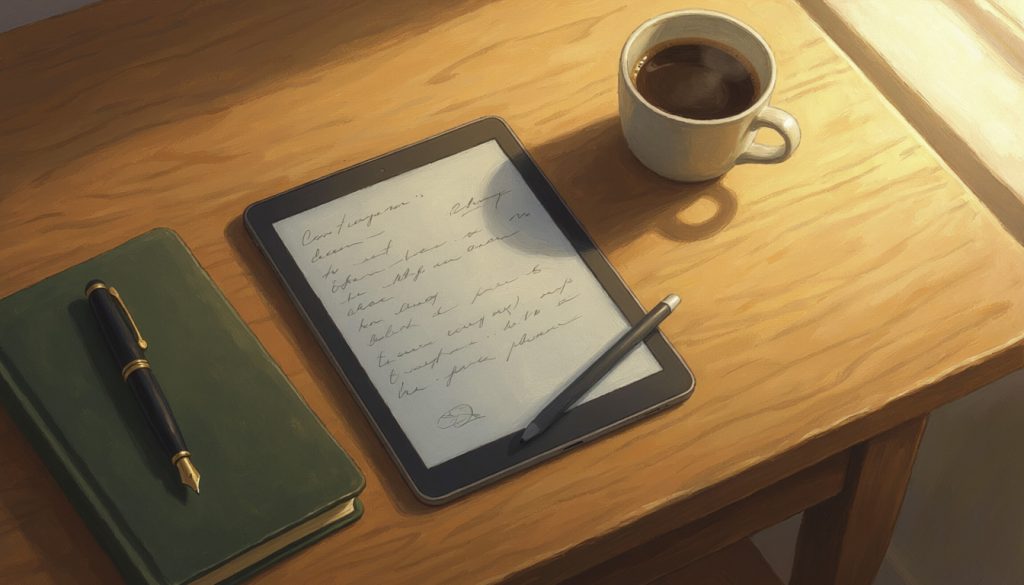
The resolution is an e-ink writing tablet: a reMarkable, a Kindle Scribe, a Boox. You get the writing feel plus search, sync, and backup — and, crucially, a device that cannot show you your inbox. The single-purpose constraint is the actual feature. The paper-like surface is a bonus.
The downsides are worth knowing. They’re expensive, some features sit behind subscriptions, handwriting recognition is good rather than perfect, and it’s another thing to carry and charge.
The cheaper entry point is a tablet and stylus you may already own — an iPad and Apple Pencil, a Galaxy Tab and S Pen, a Surface and Slim Pen. Worse as a writing surface, because it’s glass, it glares, and it holds every notification you have. Far better than not starting. A matte screen protector and an aggressive focus mode close much of the gap.
Then there’s the floor, and it isn’t a fallback so much as a structural layer: your phone, for everything the tablet isn’t present for. Dictation while walking, a typed line on a platform. E-ink for sessions, phone for interceptions, one place they both end up.
One check before you buy anything: can you get your writing out — PDF, PNG, plain text? If export is awkward, you’re renting your journal rather than keeping one.
And it closes the privacy loop neatly. An e-ink device with a PIN and notification previews switched off is one of the better answers to the household threat model — private in the way people actually want a journal to be private, rather than in the way the marketing means it.
The point isn’t the tool.
The best system is the one you’re still using a year from now, and most systems fail on availability rather than quality.
Digital’s real advantage isn’t search, or sync, or any single feature. It’s that it keeps your past self reachable.
Written with AI assistance.



Comments