


Open Questions
This is the second post in Open Questions, a series on philosophical problems I find interesting, explained as plainly as I can manage. Each post lays out a question and the strongest cases I can build on either side. Where I have a view, I’ll tell you what it is, but it goes at the end, and it’s mine, not the answer. I’m not a philosopher.
This morning an alarm went off, and somebody switched it off.
You’re sure it was you: the same person who set it last night, across a stretch of hours you remember almost nothing of.
Last time, the question was whether tomorrow would come. It came. This time the question is who turned up for it.
It looks too obvious to need asking. So did the sunrise.
The question
What makes the person who switched off the alarm the same person who set it? Or, stretching further, the same person as the child in your old school photos, who shared almost none of your opinions and none of your worries?
Sit with that for a second before reading on.
The first answer that came to me was memory. I remember setting the alarm. I remember, in patches, being that child.
Before testing it, it’s worth pulling apart two meanings of “same”, because the question tangles them. You are obviously not the same as that child in the sense of unchanged: you’re taller, you know more, you want different things. And you are obviously the same in the other sense: not a replacement or a successor, but the same person. Philosophers call these qualitative and numerical identity. The first is plainly false of you. The second is what you’re certain of.
So “I’ve changed, but I’m still me” isn’t an answer. It’s the question, stated with confidence.
(I’ve written here before about identity in the autobiographical sense: who I am, and how that has changed. This is the stranger question underneath it: what makes all those changes happen to one person.)
The circle, again
Memory is a serious answer. John Locke made it the definition in 1694: a person reaches exactly as far back as their consciousness of the past does, and no further.
But ask what makes a memory a memory.
You “remember” plenty of things that aren’t memories: a story told so often at family dinners that you can picture it, a scene you only know from a photograph, a dream vivid enough to feel like something that happened. None of those makes you the person in them. So the answer needs a qualification: genuine memories only.
Now watch what the qualification does. A memory makes you the person who set the alarm only if it’s genuine. What makes it genuine, rather than a story you absorbed? That you set the alarm. Which is exactly what the memory was supposed to establish.
If that shape looks familiar, it should. It’s the sunrise again: an answer that only works once you’ve already granted the thing it was meant to explain. Joseph Butler spotted it in 1736, three years before Hume’s Treatise: “consciousness of personal identity presupposes, and therefore cannot constitute, personal identity.”
This is worth being precise about. The problem isn’t that memory is unreliable. A perfect memory that never got anything wrong would have the same problem. Memory may be excellent evidence that you’re the same person. What it can’t be is what being the same person consists in, because what makes a memory genuine already depends on whose experience it was.
Two more exits
Two more answers usually arrive once memory falls, and both deserve their best form.
“It’s my body.”
Not a naive answer. Some philosophers hold exactly this: you are a human animal, and an animal persists the way any living thing does, by staying alive—no memories required.
The pressure comes from another of Locke’s thought experiments. Imagine a prince’s soul, carrying the memories of the prince’s life, entering the body of a cobbler. Locke thought everyone would see the result as the prince, and most people still do. Modern versions swap brains instead of souls, and the instinct doesn’t move: you go where your brain goes.
Notice what that does. It doesn’t kill the body’s answer. It narrows it, from the whole body to the organ that thinks. Hold onto that; I’ll come back to it.
“Not one memory — the whole package.”
This is the serious repair, and in some form it’s the most popular view among philosophers. You aren’t tied to the child in the photo by one memory stretching all the way back, but by an overlapping chain: today you remember yesterday, yesterday you remembered the day before, with intentions, habits and character carried along beside the memories. No single link has to reach the photo. The chain does.
It’s a much better answer. But every link is still your memory, your intention. The circle hasn’t gone; it’s been spread thinly along the chain. The only way out is to describe those links without using the word “you” at all. Someone has tried exactly that, and it’s where this series goes next.
Look for yourself
That leaves the answer people fall back on when the others give way: I don’t need a theory. I know I’m me.
This is the one Hume took apart, and you can check his work in about ten seconds. Stop reading and look inward — not at a thought or a feeling, but at the one having them.
Hume tried it in 1739. Whenever he looked, he reported, he stumbled on some particular perception: heat or cold, love or hatred, pain or pleasure. “I never can catch myself at any time without a perception,” he wrote. What we call a self, he concluded, is a bundle of perceptions in constant motion, with nothing underneath holding them together (Treatise 1.4.6).
He followed that where it led. When sound sleep removed his perceptions, he wrote, he “may truly be said not to exist.” On this view, whoever set your alarm stopped existing sometime in the night.
The best objection is the one you probably had while trying the experiment: who was doing the looking? Hume’s own report is full of “I”. His answer, in effect, is that the looking is one more perception, a thought about other thoughts, and no extra looker is needed. Whether that holds is a question for when this series reaches Descartes.
So why does it feel so strongly like one continuous you? Hume’s answer is last time’s answer, turned inward. The mind slides so smoothly along a chain of resembling, causally connected perceptions that it mistakes the chain for one unchanging thing, then invents a soul or a self to cover the joins. And when he asks whether the bond between your perceptions is real or only felt, he settles it by pointing back to what he’d already shown about cause and effect: that it comes down to custom.
The same kind of habit that makes you expect the sunrise makes you feel like one person. The connection is felt, not found.
What this is not
None of this says you don’t exist. There are thoughts, feelings, a body and a history, and nothing here takes them away. What Hume denies is one simple thing underneath that stays strictly the same while everything else changes. When he calls personal identity a fiction, he means something the mind supplies, not something it hallucinates.
And like the sunrise, it’s a belief nobody manages to give up, Hume included. At the end of the same book, after a spell of real despair, he dines, plays backgammon and is merry with his friends, and afterwards finds his speculations “so cold, and strain’d, and ridiculous” that he can’t bring himself to go back to them (1.4.7).
That makes two beliefs you can’t defend and can’t drop.
Where things stand
Hume wasn’t satisfied either. A year later, in an appendix to the Treatise, he admitted that re-reading the section had left him in “such a labyrinth” that he could neither correct his views nor make them consistent. He could see two ways out: our perceptions belong to something simple that holds them, or the mind can perceive a real connection between them. He could accept neither, and still refused to call the problem unsolvable. Scholars argue about what exactly broke; on one natural reading, a connection that’s only felt needs someone to feel it, which puts the circle back inside his own answer.
Philosophy since has split roughly along his two exits. One camp says there is a further fact about you: a simple self that can’t be broken down into anything else. Butler held a version of this, as did Thomas Reid, and Richard Swinburne defends one today. The other camp says identity consists in continuities, physical or psychological, with nothing extra underneath. The next two posts take one camp each.
It isn’t settled. In the 2020 PhilPapers survey of professional philosophers, about 44% accepted or leaned towards a psychological view, 19% a biological one and 15% a further-fact view, with the rest spread across other answers.
Where I land
Marked as mine, and more settled than last time.
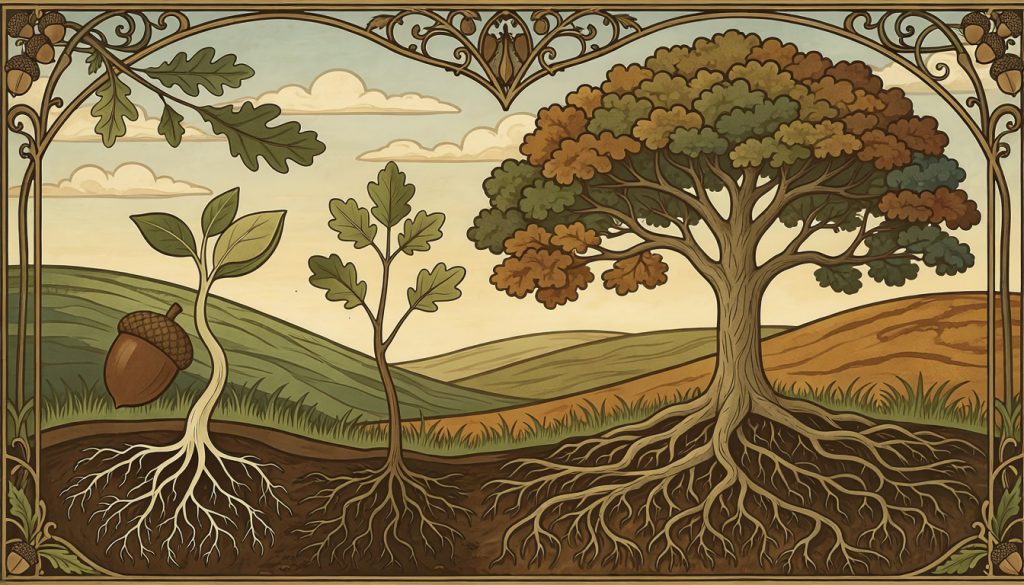
Memory was my first answer, and the circle took it away. Where I’ve ended up is with Jeff McMahan, who argues in The Ethics of Killing (2002) that we are embodied minds. What I am is a mind embodied in one particular brain: less a lump of matter than the way that matter is organised, and an organisation that persists only through continuous matter, replaced gradually, never all at once. I last as long as that brain keeps its capacity for consciousness.
That walks past the circle, because memory isn’t what makes me me. It’s evidence, and fallible evidence at that. If I lost every memory tomorrow, I’d still be here.
It answers the alarm, too. Hume thought he stopped existing in dreamless sleep. In my view, the capacity for consciousness was there all night, idle but intact, and the person who set the alarm is the one who switched it off.
And it explains why Hume’s search came up empty. The organisation that produces perceptions isn’t one of them. Looking for it among your thoughts is like looking for your own eye in your field of view.
But I have to be honest about the price, because Hume saw this move coming. He uses my picture himself: an oak that stays the same oak with not one particle of its original matter left, a mind like a commonwealth that stays one republic as its members and laws change. And he still calls that identity a fiction, for the reason we’ve already seen: a real bond would need a real connection, and all Hume thinks we ever have is custom.
So my answer needs the world to contain real connections, not just ones the mind feels. That’s what last time’s post couldn’t justify. My self is exactly as secure as my sunrise: I can’t prove either, and I can’t stop believing in either.
The view commits me to one more thing, so I’ll say it plainly. If someone built a perfect copy of my brain out of new matter, it would not be me. It would remember my life, love the same people and argue the same positions, and it would still be someone else.
Next in this series: Derek Parfit’s teleporter builds exactly that copy, and Parfit argues that whether it’s you was never the question that mattered.
Written with AI assistance.



Comments